

Ghosts do not die. That is the power of a phantom. You can bury of the cases to the chanting of the prosecutor’s fraudulent funeral rites, but its restless spirit keeps rattling through the haunted house of the UMNO Party’s premier family. The latest rattle, in which the shocking revelations that Prime Minister Najib Razak and his wife Rosmah Mansor were involved in hatching sodomy accusations against Opposition Leader Anwar Ibrahim Ghani Patail has the chance to go down in his nation’s history as either a colossal waste of a promise, or as the exorcist who rid Malaysia of the ghost of all the ghost ., the then chief minister of Malacca, Abdul Rahim Thamby Chik, was reported to have raped a 15-year-old schoolgirl (under Malaysian law, sex with a minor constitutes statutory rape). Lim Guan Eng, currently the chief minister of Penang and the then MP for Kota Melaka, spoke out against the rape of a minor after the girl’s .grandmother-cum-guardian, who was also Lim’s constituent, turned to him for help.
THE ABUSES BY A-G GANI PATAIL
by Din Merican
New York, NY - An important question confronting courts in the United States is whether individuals subjected to torture and other abuse in the "war on terror" can obtain a judicial remedy for their mistreatment. A recent decision by the US Court of Appeals for the Fourth Circuit in Richmond, Virginia, concludes that they may not.
The decision, which throws out the civil suit of former enemy combatant Jose Padilla, is troubling, both in its result and potential sweep. It not only threatens core freedoms protected by the constitution, but also undermines the principle that government officials should be held accountable for their illegal conduct.
Padilla was the victim of one of the most extraordinary uses of military detention power after the 9/11 attacks. In May 2002, Padilla was arrested by the FBI at Chicago's O'Hare International Airport and detained as a material witness in connection with the government's investigation into the attacks. The government suspected that Padilla was involved in a plot to explode a radioactive "dirty bomb" in the United States.
But rather than charge Padilla with a crime under various anti-terrorism statutes, President Bush declared him an "enemy combatant" and transferred Padilla to a navy brig in South Carolina, where he was imprisoned without access to a lawyer, a court, or his family for nearly two years. While at the brig, Padilla was held in total isolation for long periods of time, forced to endure extreme sensory deprivation, subjected to painful stress positions, and threatened with death.
In November 2005, with the Supreme Court poised to decide whether to hear Padilla's legal challenge, the Bush administration ended his military detention, indicting Padilla on criminal charges and subsequently transferring him to a federal prison. The transfer rendered Padilla's challenge to his continued military detention moot, and the Supreme Court declined to hear his case. The question remained, however, whether Padilla could seek reparations for his brutal treatment during his years of military confinement at the brig.
Seeking reparations
Padilla accordingly commenced suit against former Defence Secretary Donald Rumsfeld and other senior officials responsible for his detention and treatment as an enemy combatant. The complaint, which sought only nominal damages, was not about money, but a principle: In the United States, no person is above the law and even a state of war is not a "blank cheque" when it comes to the rights of US citizens.
In dismissing Padilla's suit at the pleading stage, before the defendants were even required to answer the complaint, the appeals court necessarily assumed the truth of Padilla's allegations. The dismissal instead rested on the more sweeping proposition that Padilla had no right to pursue any claims in federal court, no matter how brutally he was treated.
The dispute in Padilla's case centred mainly on interpretation of a 1971 case, Bivens v Six Unknown Named Agents, in which the Supreme Court had established that individuals could sue federal officials for violations of their constitutional rights. (Bivens itself involved a warrantless search and arrest in violation of the Fourth Amendment.)
| "The court's decision effectively creates a national security exception to the general principle that government officials may be held accountable for the torture and prolonged arbitrary detention of US citizens." |
There is no question that Padilla's prolonged incommunicado detention and gross mistreatment would have qualified for relief under Bivens, had it occurred as part of a "normal" law enforcement investigation - or had Padilla been a "regular" federal prisoner. The government argued, however, that because Padilla was detained by the military in the name of national security, his suit presented "special factors counselling hesitation" by the courts, thus placing it within an exception to Bivens liability. In this sensitive area, they argued, judges should not allow litigation to proceed - no matter how egregious the constitutional violation - unless Congress expressly provides for a remedy (which Congress has not).
The appeals court accepted the government's argument, concluding that allowing Padilla's suit to proceed would infringe on the prerogatives of the political branches, notwithstanding that Congress had clearly and categorically prohibited torture and other forms of mistreatment. The appeals court also found that judges lacked competence to adjudicate Padilla's claims, concluding that litigation would enmesh them in assessing government decisions about the use of interrogation methods and risk disclosure of classified information and other sensitive intelligence.
Additionally, the court dismissed Padilla's claims under the Religious Freedom Restoration Act (RFRA). Padilla, a practicing Muslim, maintained that the government had severely impeded his practice of Islam, including by denying him access to a Quran, to facilitate interrogations and deliberately confusing him about prayer times and the direction of Mecca. While RFRA plainly covered these violations of religious freedom, the court questioned whether that statute's protections applied to enemy combatants in military detention. In any event, the court said, the defendants were immune from suit because RFRA's applicability to enemy combatants was not clearly established at the time.
A national security exception
The court's decision effectively creates a national security exception to the general principle that government officials may be held accountable for the torture and prolonged arbitrary detention of US citizens. That exception is premised on a limited role for courts in enforcing constitutional protections and an aversion to holding officials liable even for the most lawless conduct in matters involving terrorism. The exception, moreover, has no limit: Under the court's reasoning, the result would have been the same if the government had waterboarded Padilla - or cut off the tips of his fingers.
Perhaps, the most cruel irony is that Padilla's military detention was made possible only because the government invoked labels such as "national security" and "enemy combatant" to circumvent established rules - above all, the requirement that individuals arrested in the United States be promptly charged with a crime and not thrown in a military stockade. Extracting an individual from the regular criminal justice system thus became the predicate for immunising government officials for any and all abuse that followed. Padilla's case demonstrates how emergency powers, even if falsely asserted and illegally invoked, can swallow the rule of law.
Padilla, to be sure, is not the most sympathetic plaintiff. Following his transfer to federal court to face charges, he was convicted of providing material support to terrorism and received a lengthy prison term. (Though it bears noting that the conviction was not based on the "dirty bomb" allegations, but on vague assertions of peripheral involvement in "jihad" during the 1990s.)
The Fourth Circuit's decision, however, did not turn on the fact that Padilla had been convicted of a crime. It applies equally to any US citizen placed in military detention, even if that person is never charged with a crime and is innocent of all wrongdoing.
The Fourth Circuit's decision will not be the last word on the subject. Padilla can appeal the decision to the full appeals court or to the Supreme Court, and his separate suit against John Yoo, an architect of Bush-era torture policies, is still pending before a federal appeals court in California. In addition, other suits by US-citizen torture victims are pending in other courts.
The Fourth Circuit's decision, nevertheless, represents a significant setback for the rule of law. It demonstrates, above all, the corrosive effects of torture, which warps legal institutions and values, ultimately co-opting courts themselves, as they become instruments of impunity.
id this case ever come to court in the first place? Why were public funds and facilities wasted to satiate the anger of a jealous husband out to destroy his former wife and her so-called enticer? And all these troubles and wastage of public facilities just for a public apology? Who paid for the court costs, the hundreds of hours that the magistrate spent hearing the case that closed with a whimper?
This is a prosecutorial misconduct, a prosecution scandal! Beyond that, this is another example of the abuses by A-G Gani Patail of his powers as the Public Prosecutor under Article 145 of the Federal Constitution. How much more abuses are we to tolerate of this A-G?!
Who is Wong Kian Kheong (WKK)?
To understand how a small private matter of no consequence to the public can end up being a prosecution case, albeit by way of a private prosecution, one has to understand the players behind the Daphne Iking’s case. It was reported that Wong Kian Kheong (WKK as how he is known in legal circles) is leading the prosecution team. Who is this WKK?
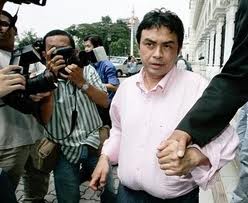 WKK was once a Deputy Public Prosecutor (DPP) and is a blue eyed boy of A-G Gani Patail. There are a lot of rumours in legal circles about WKK’s closeness to A-G Gani Patail, not less that if you want things done with A-G Chambers, go to see WKK. This rumour may be fuelled by the fact that WKK runs a flourishing criminal practice in very posh offices. But that rumour could just be pure jealousy and business rivalry. Then again, WKK has achieved amazing things that many criminal lawyers could not do. One example frequently given is the fact that WKK was the lawyer who defended Razak Baginda
Malaysians could not possibly forget the Altantuya murder case, the Mongolian beauty who was C4ed and blown to pieces. The main culprit in that case, Razak Baginda was acquitted without his defence being called, while the special forces policemen, two Unit Tindakan Khas(UTK) officers(right) were convicted and sentenced to death.
 without his defence being called, while the special forces policemen, two Unit Tindakan Khas(UTK) officers(right) were convicted and sentenced to death.
Razak Baginda was the close aide and adviser of PM Najib when Najib was the country’s Defence Minister. Altantuya and Razak Baginda were linked to Najib in the Scorpene Submarine Scandal that to this day still stained and haunts PM Najib’s premiership. MINDEF has taken steps to can any story on the Scorpene submarines that could not submerge and stay underwater.
WKK’s handling of Razak Baginda’s defence in the Altantuya murder case became controversial from the very beginning when Razak Baginda managed to get bail despite facing a murder charge. In an unprecedented step, WKK later filed a highly controversial affidavit in which explosive revelations were made, pointing the murderers to be two UTK officers, Chief Inspector Azilah Hadri and Corporal Sirul Azhar Umar. Eventually, these two UTK officers were found guilty of kidnapping and killing Altantuya while Razak Baginda was acquitted.
Upon his acquittal, Razak Baginda immediately announced that he was leaving the country to pursue further studies. That was a really absurd excuse for making an escape. Scholarship holders would tell you that if you default or dispute a PTPTN study loan, the Immigration Department would not hesitate to impound your passport and bar you from leaving the country. Here, a man summarily acquitted for murder while there could be an appeal, was allowed to leave the country. That was the greatest escapade aided and abetted by the A-G Chambers and the Immigration Department!
As a fait accompli, A-G Gani Patail announced that he, as the Public Prosecutor, would not be appealing against Razak Baginda’s acquittal. The A-G gave the excuse that he respected the court’s finding of fact to acquit Razak and thus would not pursue the case any further. This was clearly a travesty of justice!


No comments:
Post a Comment