

Annie Ooi or better known as “Aunty Bersih” and Rosni Malan, the wife of the sole Bersih 2.0 protestor who had died, have teamed up to take the election watchdog’s cause to the fore and are determined to ensure all its eight electoral reform demands are met before the polls, “or else”.
The duo, claiming to be completely independent, held a press conference today to launch a petition to the Yang di-Pertuan Agong, pleading that the Ruler invoke his constitutional powers and block any attempt by Datuk Seri Najib Razak to call for snap polls before the reforms are in place.
“I am here for the rakyat,” Ooi declared to reporters when asked who she was representing.
In the petition, Ooi and the widowed Rosni said although Najib had mooted the parliamentary select committee (PSC) to look into electoral reforms, the prime minister had, through statements made publicly, hinted that polls could be called before the panel completes its work.
They pointed to the latest pledge by “a group of Malaysians” who, on November 3, said they would mount another street gathering to prevent any election from taking place.
The “toppling of the present ruling government could not be ruled out”, the petition warned.
As such, the petition urged the Yang di-Pertuan Agong to invoke his powers under Article 40(2)(b) of the Federal Constitution which states he has the absolute discretion to withhold consent to a request by the prime minister to dissolve Parliament.
The petition said consent should be withheld if Najib attempts to call for polls: before the PSC completes its work; before all recommendations by PSC are passed in Parliament and fully implemented and; before Malaysians are convinced that the election system is free and fair.
“Now, more than ever before, His Majesty must act in the best interests of the rakyat and the nation,” Ooi wrote in a separate press statement.
“We believe the demand is reasonable... and the petition will further strengthen the respectability and position of His Majesty,” Rosni wrote in hers.
Ooi and Rosni’s husband, Baharuddin Ahmad, emerged as icons after the tumultuous rally on July 9 which saw tens of thousands take to the streets of the capital in a march for free and fair elections.
The protest, which Bersih 2.0 organisers promised was meant to be peaceful, turned chaotic at midday when riot police blared sirens and sprayed tear gas and water cannons at the marchers.
Baharuddin died during the protest while attempting the escape the bombardment of chemicals, drawing widespread condemnation from the public against the police.
The diminutive 65-year-old Ooi hit headlines when images of her frail figure drenched in chemical-laced water, eyes clenched shut and fingers clutching a long-stemmed flower flooded Facebook pages and blogs.
The retired English teacher had come alone to attend the rally and had been one of the few who dared to put on a yellow T-shirt to mark the occasion.
The event was said to have tarnished Najib’s reformist image with international media reports condemning his administration’s widespread clampdown on supporters and protestors even before the event kicked off.
Following the negative media reports, Najib went into damage control mode and after mooting the PSC, announced a raft of reforms including the repeal of the Internal Security Act, promising to increase civil liberties and relax press laws.
Let us, for a moment, forget this hype about second war of Independence. Let us also forget the minutiae of lawmaking. Leave behind, if you can, the debate between street power and parliamentary supremacy. Do not even discuss how the Anna Hazare phenomenon left the government totally out of its depth. Speculate not about whether Congress could really sense the mood of the people or has pulled another fast one on them with its resolution of sorts. The future will answer that question.
It would be easy to dismiss what we saw, as some have already done, as another of middle class fantasies with no substance. After all, it takes little to forward a few texts and emails and share stuff on Facebook. It would be easy, too, to see it as a soft way out for people to vent their frustrations. There were no bullets flying or tanks rolling on the streets. Did the crowd have the commitment to face such repression, if it came to that? We would not know.
The whole thing could be seen as just a media-driven frenzy. Pretty much like the rescue of Prince, the boy who fell into a Haryana borewell some years back. Despite gargantuan effort mounted and an entire nation rallying to save that one boy, neither our children nor our public places are safer today. Perhaps, once the present frenzy dies down, we would go back to being just as accepting of corruption as before.
Consider, instead, the incredible scenes that took place in cities and villages across the country last fortnight and the common factor among all of them: the Indian flag. Now, Indians’ love for their flag is not new. So far, though, it became evident at specific times. August 15 and January 26 were two such occasions. It also came up in government sponsored patriotic exhortations of “Mile Sur Mera Tumhara” kind. Then, as country became the world’s unofficial cricketing headquarters, the flag became a fixture at cricket matches, right from being waved in the stands to being painted on maidens’ cheeks.
During Anna Hazare’s fast, it was seen in an altogether new light. For the first time perhaps, it became a true rallying point for the ordinary folks. The people adopted it as their symbol, minus any intervention of the state. Indeed, it was used in struggle manifestly against the state. It also rose majestically above the common divisions that usually so work us up. For a brief while, under it there was no left or right, no radical or moderate, nobody representing Hindutva or Islamic points of view.
It was moving to see how it towered over the detractors and supporters alike. The Shahi Imams could not keep Muslims away from it. The Udit Rajs and Mayawatis could not keep the backwards aloof. And Bharatiya Janata Party, despite its best efforts, could do little to appropriate the movement. Here there was no tokenism seen on Independence and Republic Days. No jingoistic and synthetic national pride seen during cricket matches. Neither was it a government prompted call to patriotism.
Instead, it was symbol of something substantive. It represented a cause worth belonging to. It represented a desire of people, whether those on the streets or those supporting it on Facebook or Twitter or those merely watching the whole thing awestruck on TV, to lead a decent life. Because worse than the financial cost of corruption is the humiliation it imposes. When you pay a bribe, you lose not just money but also a bit of your pride. It is as if someone has taken advantage of your helplessness and your need. It is rape of another kind. No one enjoys it ever.
For years, we believed this humiliation had no cure. Anna Hazare’s movement touched that raw nerve. Here was a man with no political party, no trucks to transport a crowd, no money to pay the workers. He had nothing to offer but his own life. No more, but no less either. He appealed to no caste or community, made no distinction between the rich and the poor, between socialist and capitalist, between owners and employees. How else could he have mobilized support except under a flag that everybody accepted as its own? So, the tricolour went up in his tent. And, boy, did it work its magic. During the space of last 12 days, the flag became people’s and the people became flag’s. There was no government in between.
I do not know if Lokpal will become a reality the way Anna wants it. I do not know if it will make much dent on prevailing corruption. I do not know if people will respond to another such call in similar fashion. What I do know is that after this, all of us are a little more Indian than we were before in a very positive way. That is thanks to a queer old man who came from nowhere and those sublime shades of saffron, white, and green waving in the sky.
Americans are known for grandiose notions as in the song We Are The World. Its producer Quincy Jones is on his way to Dubai to help create an updated version for the Arab world, but even as the 'we are all one' rhetoric escalates, real world problems continue to get in the way.
The hopes for world unity are confronted daily by the forces of global fragmentation and polarisation, what insiders call "contagion".
On the virtual world of the Internet, there are more and more calls for general strikes as if they can be organised with one email. Manifestos soar to new rhetorical heights with demands for a worldwide occupation like this one:
The hopes for world unity are confronted daily by the forces of global fragmentation and polarisation, what insiders call "contagion".
On the virtual world of the Internet, there are more and more calls for general strikes as if they can be organised with one email. Manifestos soar to new rhetorical heights with demands for a worldwide occupation like this one:
| "We declare that we have no division among us, the people united. We are united as humanity and nature, one whole planet. We are ONE and we are here for ALL, including the one per cent! We declare that we need to take over the world agenda, to shape our future together, in a bottom-up, horizontal and egalitarian way! Let's make real democracy a reality and put an end to the 'ancient regime' of the elite." |
Ok, sounds inspiring if a tad naive, but getting from where we are to where some of today's more visionary netisens want to take us will be formidable.
Just 20-plus Occupy Wall Streeters are off on a long march to Washington from New York City to give the Congressional Super Committee a piece of their mind.
These tactics get attention, but where's the strategy?
Occupy encampments are up against local police power nationwide as officials arrest more activists and try to shut the movement down.
New York's Mayor Bloomberg, who last week exaggerated the threat the encampment off Wall Street poses, is now minimising its influence. In just a few weeks it's gone, in his estimation, from a big deal to no deal.
Just 20-plus Occupy Wall Streeters are off on a long march to Washington from New York City to give the Congressional Super Committee a piece of their mind.
These tactics get attention, but where's the strategy?
Occupy encampments are up against local police power nationwide as officials arrest more activists and try to shut the movement down.
New York's Mayor Bloomberg, who last week exaggerated the threat the encampment off Wall Street poses, is now minimising its influence. In just a few weeks it's gone, in his estimation, from a big deal to no deal.
More austerity
The marches are continuing as is the media coverage, even as the cold weather threatens and, for some, the novelty wears off.
The marches are continuing as is the media coverage, even as the cold weather threatens and, for some, the novelty wears off.
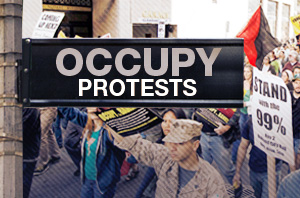 |
| In-depth coverage of the global movement |
Depressing as it may be, there is talk again of a global depression, and a "lost decade", in the words of Christine Lagarde, who heads the IMF. (The former head of that august body, Mr Strauss-Kahn is still nursing his self-inflicted wounds, a poster boy for the immorality and corruption on all levels in high places.)
Europe seems to be blowing up. As the economic crisis gets worse, a social and political crisis is sure to follow. Look for more volatility on all fronts.
First, Greece, then Italy and now Spain are, as we say, in "deep doo doo".
Europe seems to be blowing up. As the economic crisis gets worse, a social and political crisis is sure to follow. Look for more volatility on all fronts.
First, Greece, then Italy and now Spain are, as we say, in "deep doo doo".
France was forced to announce more austerity measures (Including cancelling its latest round of military spending) with many economists warning that austerity is precisely the wrong way to go because it actually raises unemployment.
Many of Europe's politicians seemed joined at the hip with bankers, and locked into a simplistic and elitest approach to economic renewal that doesn't let many facts get in the way of draconian cutbacks.
Cutting expenditures and the social safety net will raise the people against them, Austerity today, social rebellion tomorrow!
The irrational is once again trumping the rational with our problems increasingly seeming more psychiatric in origin than political. Panics always foster delusions and self-defeating scenarios.
The public is losing faith as the reputations of once great financial firms sharply decline along with faith in politicians. A left-leaning leader is going in Greece; a rightist fixture of the "Bunga Bunga" Italy has been forced out.
Whose head will be chopped next by the bond holders? The Eurozone seems to be zoning out.
Many of Europe's politicians seemed joined at the hip with bankers, and locked into a simplistic and elitest approach to economic renewal that doesn't let many facts get in the way of draconian cutbacks.
Cutting expenditures and the social safety net will raise the people against them, Austerity today, social rebellion tomorrow!
The irrational is once again trumping the rational with our problems increasingly seeming more psychiatric in origin than political. Panics always foster delusions and self-defeating scenarios.
The public is losing faith as the reputations of once great financial firms sharply decline along with faith in politicians. A left-leaning leader is going in Greece; a rightist fixture of the "Bunga Bunga" Italy has been forced out.
Whose head will be chopped next by the bond holders? The Eurozone seems to be zoning out.
And, here in America, only 8 - 9 per cent say they have confidence in Congress, and it's not clear why the pols even enjoy that record low in support. The president's popularity is way down but so is public support for Republicans. Only the mass media keeps the democratic illusion alive, between commercials, of course.
A pro-active, not reactive, OWS?
Banks are begging customers not to take their money out, even as Occupy Wall Street encourages supporters to shift funds from big financial institutions to smaller credit unions. More than $650,000 in deposits was reportedly withdrawn in one "Move Your Money" day of protest.
"More than $650,000 in deposits was reportedly withdrawn in on 'Move Your Money' day of protest." |
Objectively, this is a time when a new force can shake up politics, but is OWS, as presently constituted, that force?
Democrats won recent off-year elections on important issues like collective bargaining and abortion. But the US media prefers to dwell on the sensational rather than the analytical with more pandering coverage of GOP candidate Herman Cain's alleged sexual pecadilloes years ago than the deepening crises that confront us today.
The challenge OWS faces is how to grow from a protest movement into a political force. That will be difficult because its social base is as, if not even more, alienated from conventional politics than everyone else.
Its leaderless style, anarchistic instincts and radical impulses do not offer a sensibility that politicians feel comfortable with. They find it threatening to their pro-corporate and compromise-oriented political style.
Fears of co-optation in the movement are widespread, and so alliances are problematic. They are less consumed with market sell-offs than political sell-outs by leaders they once respected.
The movement is better at using the regular and social media, their own and the corporate press, to discuss what they are doing than what they want and how people can join them.
If OWS is to be more than a passing phenomenon, it needs to craft a new and bold pro-active (as opposed to a reactive) media strategy to reach out to the millions of disaffected Americans hard hit by the economic crisis. A few infomercials and ads might help. How else can they reach and organise the sympathy that is out there? Putting one's a-- on the line is not the same as moving masses.
OWS also needs to find a way to mobilise other institutions to disinvest from banks known for fraudulent practices, and demand that CEOS who committed crimes be jailed. Such a "jailout" would make economic justice more of a reality than more bailouts. The judicial system seems as corrupt as the financial one.
The fact that this movement is still moving is impressive, but real questions remain about where it is moving - and how it will get there.
Wall Street already occupies the world. Can OWS dislodge it?
Democrats won recent off-year elections on important issues like collective bargaining and abortion. But the US media prefers to dwell on the sensational rather than the analytical with more pandering coverage of GOP candidate Herman Cain's alleged sexual pecadilloes years ago than the deepening crises that confront us today.
The challenge OWS faces is how to grow from a protest movement into a political force. That will be difficult because its social base is as, if not even more, alienated from conventional politics than everyone else.
Its leaderless style, anarchistic instincts and radical impulses do not offer a sensibility that politicians feel comfortable with. They find it threatening to their pro-corporate and compromise-oriented political style.
Fears of co-optation in the movement are widespread, and so alliances are problematic. They are less consumed with market sell-offs than political sell-outs by leaders they once respected.
The movement is better at using the regular and social media, their own and the corporate press, to discuss what they are doing than what they want and how people can join them.
If OWS is to be more than a passing phenomenon, it needs to craft a new and bold pro-active (as opposed to a reactive) media strategy to reach out to the millions of disaffected Americans hard hit by the economic crisis. A few infomercials and ads might help. How else can they reach and organise the sympathy that is out there? Putting one's a-- on the line is not the same as moving masses.
OWS also needs to find a way to mobilise other institutions to disinvest from banks known for fraudulent practices, and demand that CEOS who committed crimes be jailed. Such a "jailout" would make economic justice more of a reality than more bailouts. The judicial system seems as corrupt as the financial one.
The fact that this movement is still moving is impressive, but real questions remain about where it is moving - and how it will get there.
Wall Street already occupies the world. Can OWS dislodge it?


No comments:
Post a Comment