
Fame is like a river, that beareth up things light and swollen, and drowns things weighty and solid. Fame is very elusive. Fame changes with time. Media and the world all run after flavour of the season and flavour of the season changes eventually. Most of the UMNO Politican don’t understand this and want to be flavour of the season for ever which is just not possible. Living in illusions in the name of being famous gives only pain to UMNO politician. Fame doesn’t last forever for anyone be it a politician, top businessman . There are so many big achievers who fade into oblivion with time. One needs to understand we are all mortals. Fame is not a permanent thing. Sticking to fame like glue have spoiled life of many celebrities and they lived unhappily and their friends also vanished with time. One must be grounded and be realistic. Fame is a byproduct of the professional success and it’s the real life success which counts. "Fame is no plant that grows on mortal soil".


“Discussion on issues like the national language, Malay and Bumiputera rights and fair allocation to states should have been settled about 20 to 30 years ago, but the government has failed to do so,” said Aziz, who was seen at the PKR Youth congress here yesterday.

The public anger against the Peaceful Assembly Bill, first proposed two months ago during Prime Minister Najib Razak’s Malaysia Day speech where he promised a repeal of oppressive laws, is founded.That's right, Malaysians should be upset at the government's duplicity in pulling such a fast one over them.
Let make it clear right at the start. It is the fundamental and constitutional right of all Malaysians to walk freely on this fair land and to have their voices heard. Yet, it is clear by now that the current establishment is out to stifle the voices of the people through legislative means ahead of a general election that has been touted to be the Mother of All Elections.
Indeed, the signs are clear that BN will not do well in the coming GE 13; something their own top leaders are very aware of. Najib is a popular leader but only according to the mainstream media and to his exorbitantly-paid public relations people.
Ask the ordinary folk, and they will giggle. Of course, they won't come to see him if 'sponsors' weren't there to hand out freebies and goodies. Also ask them, is Najib a capable leader? This time, instead of giggles, you are likely to hear thunderous laughter and snorts of scorn. The answer is fairly easy to deduce.
Two square meals a day are no longer enough
Worse still, it now appears Najib may also be a leader who has lost touch with the situation on the ground.
The introduction of the Peaceful Assembly Bill follows hot on the heels of the arrest of 13 men in Sabah under the Internal Security Act. Yes, the ISA is still in affect since the motion to have it repealed has been delayed till next year. Technically, from now until the date of its motion to be repealed, the ISA is still very much alive.
Both the Peaceful Assembly Act and the ISA have something in common, and this peculiarity showcases what may be the shallowness of Najib’s understanding of what sort of life and lifestyle that Malaysians aspire to these days.
Two square meals are no longer enough. A good job, car, house, money in the bank is good if it is possible. However, this is out of reach of the majority of Malaysians. And even if all have access to such, it won't be enough. You see, Malaysians also want 'quality of life'. They want to participate in life. This means having a say in issues that affect the lifestyles and future.
Both the Assembly Bill and the ISA give the Home Minister the final say on who or what can be banned and placed under detention without trial.
Home Minister Hishammuddin Hussein is the hidden hand or play-master behind introduction and the use of these two most repressive of acts in Malaysia. And if many are wondering who came up with the contents of the Assembly Bill, the finger should be pointed to Hishammuddin Hussein. Interestingly, the Home Minister did not read out the Assembly Bill in Parliament, but left the job to the Prime Minister, citing voice problems - the Home Minister lost his voice! Was his own Assembly Bill so horrible that it robbed him of his voice?
It seems a case of the chef cooking up a complex dinner menu and leaving it to the host of the house to explain to his guest, why the food tasted so bad!
Very dangerous
And with all things Barisan Nasional, there are no clear explanation as to why such odd restrictions were dreamed off in the Assembly Bill nor are we informed as to why 13 men were detained under the ISA. Bear in mind, the 13 men detained were PAS members and the reason so far was that “they were very dangerous men”. It is not far-fetched to predict that we will be presented with some rather incriminating “evidence” soon as to the 13 men’s guilt but that will come after much public pressure, leaving us to wonder - how much of the evidence was fabricated or worse, forcibly extracted?
It is a shame to insinuate that Najib has no idea what is happening in this country. He may be the poster-boy of Barisan Nasional and one who makes the most glowing of announcements, mimicking the style of ace presenter, the late Steve Jobs when selling Apple products. But that is all Najib seem to be good at. Overseas trips, spending when abroad and slip-shod work when he returns.
Make no mistake though, he and Hisham - who is also his trusted cousin - are the play-masters in the latest Assembly Bill and the ISA arrests. It is not the police who have final say in what and who can hold assemblies or be detained without trial. It is Hishammuddin, by virtue of being the Home Miniser, who has the ultimate say as the police would report back to him.
What disaster is now in store for Malaysia? It is scary to have the likes of Hishammuddin waiting and biding his time to sit in the premier's seat, which is the ultimate goal of his political ambitions. The introduction of the Assembly Bill and the repeal of the ISA are not "revolutionary" nor a "giant leap" as Najib insists.
Instead, the Bill and its crude and blatant purpose of wanting to oppress Malaysians in this day and age give reason for Malaysians to have a revolution and return the mandate of authority back to the people. Malaysia is better run by its citizens than to be commandeered by a pack of half-baked and corrupt politicians.

1. Which political party has embraced Ibrahim Ali and Perkasa?
2. Which political party owns the most rabid and anti-national unity/anti-non-Malay newspaper in the country?
3. Which political party has played the race and religion card continuously since the last election?
4. Which political party leads a Cabinet whose ministers dare not declare their assets?
5. Which political party has a minister who is involved in the National Feedlot Centre scandal?
6. Which political party has created division in Malaysia by accusing Christians of trying to take over the government and by endorsing the parading of a cow head in Shah Alam?
7. Which political party took over power unconstitutionally in Perak?
8. Which political party used the police to fire tear gas and arrest its own citizens who wanted free and fair elections?
9. Which political party has the most number of senior officials without a job but appear to be living in the lap of luxury?
10. Which political party needed to coin its own phrase “money politics” to hide the fact that corruption is in its DNA today?
With dizzying speed, Prime Minister Najib Tun Razak tabled several new laws to fulfill an earlier pledge to give Malaysians the “best democracy in the world”.
Meanwhile, political pundits criticise Najib’s “rash of reforms” saying that they were an over-reaction to public sentiment in the run-up to GE-13.
Their skepticism stems from the action of Syrian President Bashar al-Assad, who promised envoys from the UN Security Council, that he was “committed to the reform process.” The Syrian uprising has left 3,500 dead, scores injured and thousands detained.
Other cynics said, “Najib is not capable of a rash reform. The only rash he knows is when he was hospitalised with (chicken) pox last year.”
Perhaps “better late than never” could be another Barisan Nasional slogan. BN has taken four decades to repeal the Internal Security Act (ISA) 1960 and should be praised for being receptive to the mood of the nation.
Nevertheless, reforms help distract and reduce the rakyat’s worries about electoral fraud and the National Feedlot Corporation’s alleged misuse of RM250 million of taxpayers’ money.
At the weekend, BN confirmed that they were wooing young voters. Foreign PR consultants, which cost the Malaysian taxpayer millions, are finally proving they are value for money. They gave BN leaders some useful advice. They confirmed our long-held belief that our youth is well versed in the use of digital media.
As a result, Najib and his home minister have their own version of the mobile phone and music shop sales pitch: “Trade in your old law for two new ones”. Home Minister Hishammuddin Hussein, earlier announced two new laws to replace the ISA.
The students were promised an amendment to the Universities and University Colleges Act 1974 (UUCA) so that they could join political parties at 21. The PM said he valued “the maturity and wisdom of undergraduates”.
Like any other wise parent, Najib exercises caution by ensuring that our youth is not troubled by too many liberties. He barred them from bringing partisan politics onto campuses. He cherishes the old-fashioned view that students cannot make sound judgements without consulting their parents, the university’s governing body or the authorities.
Maybe he is worried that studies would be disrupted. He probably read about UK students wreaking havoc in the centre of London, whilst increasing public awareness about cuts in education.
It is probable he didn’t want copy-cat acts similar to the Tunisian street vendor, an allegedly unemployed student, who immolated himself, when he was harassed by the police.
As expected, the home minister reiterated that the two new laws to replace the ISA would still include detention without trial.
Najib’s giant step
But many political observers were surprised when Hishammuddin stressed that the process of replacing the ISA had begun two years ago.
Someone who had been arrested during the ISA protest at Amcorp Mall in August 2010 said, “I suppose we were so busy protesting, that we failed to notice that the government had started dismantling the ISA.”
A “Gerakan Mansuhkan ISA” protester based in England, known to religiously attend every Saturday afternoon protest outside the Malaysian Tourist Office in Trafalgar Square said: “Perhaps it’s for the best. Protesting in summer is like a day out. What could be better than downing ale whilst watching pretty girls walk past? But winter is depressing. When it’s wet and cold, I can easily imagine what it feels like to be in a damp cell in Kamunting.”
Hishammuddin’s justification for Malaysia’s detention without trial is centred on the United States Patriot Act and the Anti-Terrorism Acts in the United Kingdom and Australia.
BN supporters are afraid that in trying to be like the UK and US, Malaysia might also have to curb its human rights abuses.
They disagree with the western emphasis on human rights: “See what happens when you are soft on people. They riot. Then they rob you. We should be thankful that BN does not riot.”
In contrast, a pro-government party member believed that the new laws should make it easier for the authorities to stifle political dissenters. “The ISA was a burden. They (the authorities) had to plant Che Guevara T-shirts or Mao propaganda leaflets in bags of people who were potential trouble-makers. Arrests are only possible when national security is threatened.”
Last week, Najib announced the Peaceful Assembly Bill 2011, which he termed a “revolutionary” law and a “giant step” towards improving individual freedom. He denied claims that the Act choked the freedom to assemble. He assured protesters of a fine and spared them time behind bars.
A political observer said, “BN is desperate for money. They need to buy votes in GE-13 and the coffers are empty. Taxpayers’ money has been directed into emergency funds overseas, in case the BN leaders need to escape.”
Najib said that gatherings were only prohibited in, or near, selected sites. He rambled on whilst reading his short list which included hospitals, schools, petrol stations, fire stations, airports, railways, land public transport terminals, ports, canals, docks, bridges, places of worship, kindergartens, schools, dams, reservoirs and streets.
He rubbished claims that assemblies were banned “anywhere and everywhere”.
Interests of rakyat
Unlike the opposition, several people were content. The local Mat Rempit groups, when contacted, were grateful that highways were exempt. Funeral parlours also breathed a sigh of relief that they were free of the 30 days’ advance warning before the funeral cortège.
They had been worried about space constraints and deterioration of the bodies.
The PM spared parents the embarrassment of refusing to participate in a march by giving them a ready-made excuse. He knows that baby-sitters are difficult to find and he advised would-be marchers to tell the organisers that the police could arrest anyone who brought or recruited children to rallies.
Former PM Dr Mahathir Mohamad, who has disagreed with Najib on almost every subject, offered Najib the olive branch by saying he approved of the Peaceful Assembly Bill 2011. This cementing of ties cannot have come at a worse time for the opposition.
Nevertheless, both Mahathir and Najib only have the interests of the rakyat at heart. They did not want protesters to succumb to the temptation of looting shops. They were worried that roads which were free of traffic meant that tolls could not collect revenue.
BN supporters rejected opposition claims that shopkeepers who remained open during the Bersih 2.0 rally enjoyed brisk trading.
They also dismissed footage by foreign news media, that showed the police firing tear-gas at peaceful protesters. They refuted claims that water cannons were deployed for crowd-control and condemned the “western conspiracy” to undermine Najib’s administration.
A pro-government activist said, “Protesters should be thankful only a little violence was used. Tear gas and water jets are preferable to rubber bullets. The police must preserve the peace.”
Mariam Mokhtar
The Barisan Nasional (BN) government has failed to address fundamental issues that should have been resolved long ago, Prof Dr Abdul Aziz Bari said last night.
The International Islamic University law lecturer said this was because Putrajaya had created restrictions that were not in line with the people’s needs.
“Discussion on issues like the national language, Malay and Bumiputera rights and fair allocation to states should have been settled about 20 to 30 years ago, but the government has failed to do so,” said Aziz, who was seen at the PKR Youth congress here yesterday.
This is the second time this month the constitutional law expert has attended a PKR event in Johor.
Aziz, who has been mired in controversy for over a month after commenting on the Selangor Sultan’s intervention in a church raid, urged Malaysians to vote in a new government to ensure such issues were tackled quickly.
“We need a government that’s committed to resolving these issues. It will be hard for us to create laws if we don’t control Parliament and if there’s no change in the leadership in Putrajaya,” he said.
He praised Pakatan Rakyat (PR) for letting the people discuss critical issues more openly and freely.
“I see a new boldness after 54 years of independence. Now we can discuss these issues openly. It’s clear that through Pakatan Rakyat’s struggle, we have gained more freedom to discuss such issues,” he said.
Earlier this month, Higher Education Minister Datuk Seri Mohamed Khaled Nordin advised Aziz to resign as an academic if he wished to be involved in politics and not wait for the university to take action.
Aziz is being investigated by UIA for commenting on the Selangor Sultan’s remarks concerning the raid by Islamic religious authorities on the Damansara Utama Methodist Church (DUMC) in August.
Khaled, who is also Pasir Gudang MP, said he was aware that Aziz had entered his constituency to deliver speeches but remained confident voters here would not be taken in by his words.
The Selangor Sultan earlier this week expressed his disappointment with Aziz’s claim that the Selangor Islamic Religious Council and Selangor Zakat Board had not been audited.
San Fransico, CA - Last Tuesday, I awoke in lower Manhattan to the whirring of helicopters overhead, a war-zone sound that persisted all day and then started up again that Thursday morning, the two-month anniversary of Occupy Wall Street and a big day of demonstrations in New York City. It was one of the dozens of ways you could tell that the authorities take Occupy Wall Street seriously, even if they profoundly mistake what kind of danger it poses. If you ever doubted whether you were powerful or you mattered, just look at the reaction to people like you (or your children) camped out in parks from Oakland to Portland, Tucson to Manhattan.
Of course, "camped out" doesn't quite catch the spirit of the moment, because those campsites are the way people have come together to bear witness to their hopes and fears, to begin to gather their power and discuss what is possible in our disturbingly unhinged world, to make clear how wrong our economic system is, how corrupt the powers that support it are, and to begin the search for a better way. Consider it an irony that the campsites are partly for sleeping, but symbols of the way we have awoken.
When civil society sleeps, we're just a bunch of individuals absorbed in our private lives. When we awaken, on campgrounds or elsewhere, when we come together in public and find our power, the authorities are terrified. They often reveal their ugly side, their penchant for violence and for hypocrisy.
Consider the liberal mayor of Oakland, who speaks with outrage of people camping without a permit but has nothing to say about the police she dispatched to tear-gas a woman in a wheelchair, shoot a young Iraq war veteran in the head, and assault people while they slept. Consider the billionaire mayor of New York who dispatched the NYPD on a similar middle-of-the-night raid on November 15. Recall this item included in a bald list of events that night: "Tear-gassing the kitchen tent." Ask yourself when did kitchens really need to be attacked with chemical weapons?
Does an 84-year-old woman need to be tear-gassed in Seattle? Does a three-tours-of-duty veteran need to bebeaten until his spleen ruptures in Oakland? Does our former poet laureate need to be bashed in the ribs after his poet wife is thrown to the ground at UC Berkeley? Admittedly, this is a system that regards people as disposable, but not usually so literally.
Two months ago, the latest protests against that system began. The response only confirms our vision of how it all works. They are fighting fire with gasoline. Perhaps being frightened makes them foolish. After all, once civil society rouses itself from slumber, it can be all but unstoppable. (If they were smart they'd try to soothe it back to sleep.) "Arrest one of us; two more appear. You can't arrest an idea!" said the sign held by a man in a Guy Fawkes mask in reoccupied Zuccotti Park last Thursday.
Last Wednesday in San Francisco, 100 activists occupied the Bank of America, even erecting a symbolic tent inside it in which a dozen activists immediately took refuge. At the Berkeley campus of the University of California, setting up tents on any grounds was forbidden, so the brilliant young occupiers used clusters of helium balloons to float tents overhead, a smart image of defiance and sky-high ambition. And the valiant UC Davis students, after several werepepper-sprayed in the face while sitting peacefully on the ground, evicted the police, chanting, "You can go! You can go!" They went.
Occupy Oakland has been busted up three times and still it thrives. To say nothing of the other 1,600 occupations in the growing movement.
Alexander Dubcek, the government official turned hero of the Prague Spring uprising of 1968, once said: "You can crush the flowers, but you can't stop the spring."
The busting of Zuccotti Park and the effervescent, ingenious demonstrations elsewhere are a reminder that, despite the literal "occupations" on which this protean movement has been built, it can soar as high as those Berkeley balloons and take many unexpected forms. Another OWS sign: "The beginning is near," caught the mood of the moment. Flowers seem like the right image for this uprising led by the young, those who have been most crushed by the new economic order, and who bloom by rebelling and rebel by blooming.
The best and the worst
Now world-famous Zuccotti Park is just a small concrete and brown marble-paved scrap of land surrounded by tall buildings. Despite the "Occupy Wall Street" label, it's actually two blocks north of that iconic place. It's rarely noted that the park is within sight of, and kitty-corner to, Ground Zero, where the World Trade Centre towers crumbled.
What was born and what died that day a decade ago has everything to do with what's going on in and around the park, the country, and the world now. For this, al-Qaeda is remarkably irrelevant, except as the outfit that long ago triggered an incident that instantly released both the best and the worst in our society.
The best was civil society. As I wandered in the Zuccotti Park area last week, I was struck again by how much what really happened on the morning of September 11 has been wilfully misremembered. It can be found nowhere in the plaques and monuments. Firemen more than deserve their commemorations, but mostly they acted in vain, on bad orders from above, and with fatally flawed communications equipment. The fact is: the people in the towers and the neighbourhood - think of them as civil society coming together in crisis - largely rescued themselves, and some of them told the fire-fighters to head down, not up.
We need memorials to the co-workers who carried their paraplegic accountant colleague down 69 flights of stairs while in peril themselves; to Ada Rosario-Dolch, the principal who got all of the High School for Leadership, a block away, safely evacuated, while knowing her sister had probably been killed in one of those towers; to the female executives who walked the blind newspaper seller to safety in Greenwich Village; to the unarmed passengers of United Flight 93, who were the only ones to combat terrorism effectively that day; and to countless, nameless others. We need monuments to ourselves, to civil society.
Ordinary people shone that morning. They were not terrorised; they were galvanised into action, and they were heroic. And it didn't stop with that morning either. That day, that week, they began to talk about what the events of 9/11 actually meant for them, and they acted to put their world back together, practically and philosophically. All of which terrified the Bush administration, which soon launched not only its "global war on terror" and its invasion of Afghanistan, but a campaign against civil society. It was aimed at convincing each of us that we should stay home, go shopping, fear everythingexcept the government, and to spy on each other.
The only monument civil society ever gets is itself, and the satisfaction of continuing to do the work that matters, the work that has no bosses and no pay cheques, the work of connecting, caring, understanding, exploring, and transforming. So much about Occupy Wall Street resonates with what came in that brief moment a decade before and then was shut down for years.
That little park that became "occupied" territory brought to mind the way New York's Union Square became a great public forum in the weeks after 9/11, where everyone could gather to mourn, connect, discuss, debate, bear witness, share food, donate or raise money, write on banners, and simply live in public. (Until the city shut that beautiful forum down in the name of sanitation - that sacred cow which by now must be mating with the Wall Street Bull somewhere in the vicinity of Zuccotti Park.)
It was remarkable how many New Yorkers lived in public in those weeks after 9/11. Numerous people have since told me nostalgically of how the normal boundaries came down, how everyone made eye contact, how almost anyone could talk to almost anyone else. Zuccotti Park and the other Occupies I've visited - Oakland, San Francisco, Tucson, New Orleans - have been like that, too. You can talk to strangers. In fact, it's almost impossible not to, so much do people want to talk, to tell their stories, to hear yours, to discuss our mutual plight and what solutions to it might look like.
It's as though the great New York-centric moment of openness after 9/11, when we were ready to re-examine our basic assumptions and look each other in the eye, has returned, and this time it's not confined to New York City, and we're not ready to let anyone shut it down with rubbish about patriotism and peril, safety and sanitation.
It's as if the best of the spirit of the Obama presidential campaign of 2008 was back - without the foolish belief that one man could do it all for civil society. In other words, this is a revolt, among other things, against the confinement of decision-making to a thoroughly corrupted and corporate-money-laced electoral sphere and against the pitfalls of leaders. And it represents the return in a new form of the best of the post-9/11 moment.
As for the worst after 9/11 - you already know the worst. You've lived it. The worst was two treasury-draining wars that helped cave in the American dream, a loss of civil liberties, privacy, and governmental accountability. The worst was the rise of a national security state to almost unimaginable proportions, a rogue state that is our own government, and that doesn't hesitate to violate with impunity the Geneva Convention, the Bill of Rights, and anything else it cares to trash in the name of US "safety" and "security". The worst was blind fealty to an administration that finished off making this into a country that serves the one per cent at the expense, or even the survival, of significant parts of the 99 per cent. More recently, it has returned as another kind of worst: police brutality (speaking of blind fealty to the one per cent).
Civil society gets a divorce
You can think of civil society and the state as a marriage of convenience. You already know who the wife is, the one who is supposed to love, cherish, and obey: that's us. Think of the state as the domineering husband who expects to have a monopoly on power, on violence, on planning and policymaking.
Of course, he long ago abandoned his actual wedding vows, which means he is no longer accountable, no longer a partner, no longer bound by the usual laws, treaties, conventions. He left home a long time ago to have a sordid affair with the Fortune 500, but with the firm conviction that we should continue to remain faithful - or else. The post-9/11 era was when we began to feel the consequences of all this and the 2008 economic meltdown brought it home to roost.
Think of Occupy as the signal that the wife, Ms Civil Society, has finally acknowledged that those vows no longer bind her either. Perhaps this is one reason why the Occupy movement seems remarkably uninterested in electoral politics while being political in every possible way. It is no longer appealing to that violent, errant husband. It has turned its back on him - thus the much-decried lack of "demands" early on, except for the obvious demand the pundits pretended not to see: the demand for economic justice.
Still, Ms Civil Society is not asking for any favours: she is setting out on her own, to make policy on a small scale through the model of the general assembly and on a larger scale by withdrawing deference from the institutions of power. (In one symbolic act of divorce, at least three quarters of a million Americans have moved their money from big banks to credit unions since Occupy began.) The philandering husband doesn't think the once-cowed wife has the right to do any of this - and he's ready to strike back. Literally.
The Occupy movement has decided, on the other hand, that it doesn't matter what he thinks. It - they - she - we - soon might realise as well that he's actually the dependent one, the one who rules at civil society's will, the one who lives off her labour, her taxes, her productivity. Mr Unaccountable isn't anywhere near as independent as he imagines. The corporations give him his little treats and big campaign donations, but they, too, depend on consumers, workers, and ultimately citizens who may yet succeed in reining them in.
In the meantime, a domestic-violence-prone government is squandering a fortune on a little-mentioned extravagance in financially strapped American cities: police brutality, wrongful arrest, and lawsuits over civil-rights violations. New York City - recall those pepper-sprayed captive young women, that legal observer with a police scooter parked on top of him, and all the rest - you're going to have a giant bill due in court, just as you did after the 2004 Republican convention fiasco: New York has spent almost a billion dollars paying for the collateral damage already done by its police force over the past dozen years.
The desperately impoverished city of Oakland paid out more than $2m in recompense for the behavior of the Oakland Police at a nonviolent blockade at the Oakland Docks after the invasion of Iraq broke out in 2003, but seems to have learned nothing from it. Surely payouts in similar or larger quantities are due to be handed out again, money that could have gone to schools, community clinics, parks, libraries, to civilization instead of brutalisation.
Out of the ruins
Maybe the teardown of Zuccotti Park last Wednesday should be seen as a faint echo of the attacks of September 11, 2001. Structures, admittedly far more flimsy, were destroyed, violently, by surprise attack, and yet resolve was only strengthened - and what was lost?
The encampment had become crowded and a little chaotic. There was the admirable bustle of a village - bicycle-powered generators on which someone was often pedalling; information, media, and medic sites whose staff worked devotedly; a kitchen dispensing meals to whoever came; and of course, the wonderful library dumpstered by the agents of the law. There were also a lot of people who had been drawn in by the free food and community, including homeless people and some disruptive characters, all increasingly surrounded by vendors of t-shirts, buttons, and other knick-knacks trying to make a quick buck.
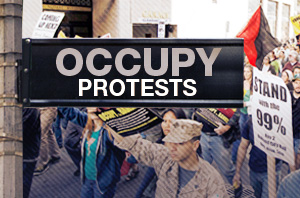 |
| In-depth coverage of the global movement |
One of the complicating factors in the Occupy movement is that so many of the thrown-away people of our society - the homeless, the marginal, the mentally ill, the addicted - have come to Occupy encampments for safe sleeping space, food, and medical care. And these economic refugees were generously taken in by the new civil society, having been thrown out by the old uncivil one.
Complicating everything further was the fact that the politicians and the mainstream media were more than happy to blame the occupiers for taking in what society as a whole created, and for the complications that then ensued. (No mayor, no paper now complains about the unsanitariness of throwing the homeless and others back onto the streets of our cities as winter approaches.)
Civil society contains all kinds of people, and all kinds have shown up at the Occupy encampments. The inclusiveness of such places is one of the great achievements of this movement. (Occupy Memphis, for instance, has even reached out to Tea Party members.) Veterans, students, their grandparents, hitherto apolitical people, the employed and unemployed, the housed and the homeless, and people of all ages and colours have been drawn in along with the unions. And yes, there are also a lot of young white activists, who can be thanked for taking on the hard work and heat. We can only hope that this broad coalition will hang together a while longer.
It gets better
And, of course, just as civil society is all of us, so some of us have crossed over to become that force known as the state, and even there, the response has been more varied than might be imagined. New York City Councilman Ydanis Rodriguez got scraped up and arrested by the NYPD when he tried to walk past a barricade two blocks from Wall Street while the camp was being cleared. And retired New York Supreme Court judge Karen Smith got shoved around a little and threatened with arrest while acting as a legal observer.
A councilwoman in Tucson, Regina Romero, has become a dedicated advocate for the Occupy encampment there, and when the San Francisco police massed on the night of November 3, five supervisors, the public defender, and a state senator all came to stand with us.
I got home at 2am that night and wrote: "Their vows to us felt like true representative democracy for the first time ever, brought to us by the power of direct democracy: the Occupy Movement. I thought of the Oath of the Horatii, David's great painting in the spirit of the French Revolution. The spirit in the plaza was gallant, joyous, and ready for anything. A little exalted and full of tenderness for each other. Helicopters hovered overhead, and people sent back reports of buses and massed police in other parts of town. But they never arrived."
Former Philadelphia Police Captain Ray Lewis actually came to Wall Street to get arrested last week. "They complained about the park being dirty," he said. "Here they are worrying about dirty parks when people are starving to death, where people are freezing, where people are sleeping in subways, and they're concerned about a dirty park. That's obnoxious, it's arrogant, it's ignorant, it's disgusting."
And the Army, or some of its most honourable veterans, are with the occupiers, too. In the Bay Area, members of Iraq Veterans Against the War have been regular participants, and Occupy Wall Street has had its larger-than-life ex-marine, Shamar Thomas, clad in worn fatigues and medals. He famously told off the NYPD early on: "This is not a war zone. These are unarmed people. It doesn't make you tough to hurt these people. It doesn't. Stop hurting these people!"
To my delight, at Occupy Wall Street I ran into him, almost literally, still wearing his fatigues and medals and carrying a sign that said, "There's no honour in police brutality" on one side and "NO WAR" on the other. Which war - the ones in the Greater Middle East or on the streets of the USA - hardly seemed to matter: they're one war now, the war of the one per cent against the rest of us. I told him that his tirade was the first time I ever felt like the US military had actually defended me.
Right now everyone is trying to figure out what happens next and quite a few self-appointed outside advisers are telling the Occupy movement exactly what to do (without all the bother of attending general assemblies and engaging in the process of working out ideas together). So far, the Occupy instigators and Occupy insiders have been doing a brilliant job of improvising a way that civil society can move forward into the unimaginable.
As for me, the grounds of my hope have always been that history is wilder than our imagination of it and that the unexpected shows up far more regularly than we ever dream. A year ago, no one imagined an Arab Spring, and no one imagined this American Fall - even the people who began planning for it this summer. We don't know what's coming next, and that's the good news. My advice is just of the most general sort: Dream big. Occupy your hopes. Talk to strangers. Live in public. Don't stop now.
I'm sure of one thing: there are a lot more flowers coming.


No comments:
Post a Comment