

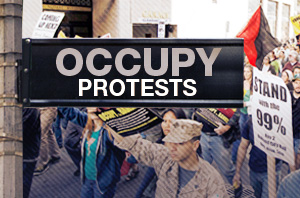
When a UC Davis police officer, Lt. John Pike, took out a can of pepper spray andcalmly doused a group of passive, nonviolent Occupy protesters sitting on a campus pathway, he should have known that all of the world would witness his horrific act. There were scores of people watching the scene unfold, nearly every one of them with a video camera in his or her pocket smartphone. Within hours of Pike's attack, the video went viral, uploaded onto websites like YouTube and shared via text messages, emails, tweets and Facebook status updates.
The only good thing about this incident is that everyone could see it. Thanks to technology, we have entered a new era of citizen oversight of the police. The behavior and actions of police officers are increasingly captured on digital cameras and opened up to broad public examination. And the long-term result is likely to be a significant -- and welcome -- reduction in police misconduct.
Ever since spectators recorded the unjustified shooting of Oscar Grant on an Oakland commuter train platform in 2009, it seems there's a new video or photograph of police brutality distributed for the masses to see each week. The Occupy movement in particular has been on the receiving end of several violent police attacks caught on camera, from the pepper-spraying by Seattle police of Dorli Rainey, an 84-year-old retired schoolteacher, to the beating of Kayvan Sabehgi, a veteran of the war in Iraq, by baton-wielding Oakland cops.
Traditionally, police abuses were easier to hide. Most interactions with police and private citizens, even those on the public streets, weren't likely to be recorded. Although spectators occasionally captured incidents on tape -- like the infamous Rodney King beating in 1991 -- few people carried around video cameras while they went about their daily routines. Now people have quick access through their iPhones or other smartphones, which include video recording as a standard feature.
For individual victims, having a video or audio recording of an encounter with police can provide the crucial evidence necessary to prove a complaint about misconduct. Such complaints usually come down to "he said, cop said" situations and the credibility battle is usually titled heavily in favor of the lawman over the suspected criminal.
The benefit of the new police surveillance, however, will be enjoyed by everyone. As the legendary Supreme Court Justice Louis Brandeis reminded us a century ago, "sunlight is said to be the best of disinfectants." People who know or suspect they are being watched are more likely to behave appropriately and follow the rules. Given police officers' authority to use force on citizens, it is a vital that cops obey the Constitution, federal and state law, and the protocols of their departments.
Too often police officers abuse that authority. Yet now citizens like Simon Glik have a "weapon" with which to fight back. As Glik was walking past Boston Common on a fall evening in 2007, he saw three police officers arresting a young man and using what Glik thought was excessive force. So Glik took out his digital cell phone camera and recorded what he saw. Unhappy to be caught on candid camera, the police turned around and arrested Glik -- for violating the state's anti-wiretapping law.
This has been the unfortunate response of some police departments to people who record their actions in public. Many states have such laws, which are designed to protect ordinary people from being secretly recorded. Even though these laws were not intended to cover police officers working on the public streets, who have no reasonable expectation of privacy, some police forces and their allies in the prosecutor's office have been discouraging citizen oversight by punishing people who record police misconduct.
As a federal court which ruled in August on the case of Simon Glik explained, "Gathering information about government officials in a form that can be readily disseminated to others serves a cardinal First Amendment interest in protecting and promoting the free discussion of governmental affairs." Free speech, the court continued, "has particular significance with respect to the government because it is here that the state has a special incentive to repress opposition and often wields a more effective power of suppression."
That cell phone in your pocket thus serves the values of free speech - and not because you can call your friends on it. Your digital camera and voice recorder is the new mechanism to insure that We the People can watch over the police and check their excesses.

Pakatan Rakyat (PR) lawmakers poured cold water today over Putrajaya’s plans to lift the ban on students in politics, saying it was a window-dressing move aimed to woo young voters.
Several MPs pointed out that the unexpected announcement made by Datuk Seri Najib Razak in Parliament this morning had come with several disclaimers — that students must be aged above 21 to become political party members; that politics would remain prohibited from campuses; and that the government would still appeal a recent court ruling declaring the ban unconstitutional.
“The bottom line is — nothing has changed,” said DAP’s Segambut MP Lim Lip Eng.
“On the one hand, you said you will amend the law, on the other, you say you will appeal the decision. On the one hand, you say they can become political party members, on the other, you say politics are not allowed in campus.
“Only one word to describe this — oxymoron,” he told The Malaysian Insider.
PAS’s Kuala Selangor MP Dr Dzulkefly Ahmad (picture) agreed, and accused Najib of attempting to woo young voters with the “window-dressing” move.
“Only one thing is for certain...they are doing this for the sole reason of winning over young voters. To me, there is no two-ways about it — they should just completely abolish the law,” he said.
When tabling a motion to lift three Emergency declarations this morning, Najib said the government would soon amend Section 15 of the University and University Colleges Act (UUCA) to allow students aged above 21 to become members of political parties.
He stressed however that the government would still appeal the recent court ruling declaring the section unconstitutional and that politics in campuses would still be strictly prohibited.
In a majority 2-1 judgement earlier this month, a three-man panel of judges ruled that Universiti Kebangsaan Malaysia (UKM) had breached Article 10 of the country’s highest law when it disciplined four students involved in a political campaign last year under Section 15(5)(5)(a) of the UUCA.
“This is what I call a great confusion. With elections looming so close, Najib and his team are trying out this window-dressing move, pulling wool over the people’s eye to hoodwink them into thinking the government is their saviour,” said Dzulkefly.
He added that universities presently have their own respective by-laws and constitutions, which he said was enough to govern its operations, including student movement.
PAS’s Pokok Sena MP Datuk Mahfuz Omar said the government’s decision to appeal the decision would contradict its plan to amend Section 15 of the law.
He said Putrajaya should not proceed with the appeal to prove its sincerity in amending the law, adding that Najib, in his speech this morning, had not detailed if the proposed amendments would grant students total freedom to participate in politics, including holding positions in political parties.
“What is important to me is that students and academicians be given full opportunities to discuss openly ideas and matters of national importance both inside and outside the campus... it is not just about allowing them to join political parties,” he said. Dr Dzulkefly said the government needed to allow greater freedom to students and academicians in order to breed more intellectuals in society.
“We want alert-minded intellectuals, enterprising graduates, morally upright, intellectually superior... you cannot have that in an environment that breeds bigotry. Bigots are not intellectuals,” he said.
PKR’s Subang MP R. Sivarasa concurred and pointed out to the declining state of Malaysian universities, saying local institutions do not provide an “atmosphere of open, critical thinkers”.
He also accused the government of practising double standards, saying that while politics was banned in local campuses, Umno has student clubs formed in foreign institutions.
related article http://suarakeadilanmalaysia.wordpress.com/2011/11/22/hishamuddins-police-assaulting-protesters-booze-and-ladies-all-you-need-in-life/
San Pedro, CA - The viral video of Lt John Pike casually pepper-spraying a line of peacefully seated student protesters has deep resonance for the Civil Rights generation. It's impossible to escape comparisons to Bull Connor ordering the use of fire hoses on the black youth of Birmingham on May 3, 1963. Pike sprays the students' faces as if they were cockroaches, many have said. The youth of Birmingham were sprayed with such force that some were knocked over like paper dolls. But it was segregation that was about to fall. The UC Davis students face a much more formidable foe, not least because it is harder to define. But their sacrificial courage holds the promise of helping to change that.
The details may differ between Davis and Cairo, but the underlying struggle is fundamentally the same: It is not just youth against age, freedom against repression, innocence against cynicism, hope against fear, dreams against nightmares - it is all that and more. But it is also something historically much more specific. It is the neo-liberal promise against its own grim reality, represented in the street battles in and around Tahrir Square, as well as the pepper-spraying of docile students at UC Davis.
How does it come about that this is the example that America sets for the world? How does a purported liberal democracy become a police state? The drama at Davis provides two paths towards answering that question.
First is the bizarre bifurcation of America's First Amendment freedoms, with one virtually unlimited form for 1%, who really don't need any protection, and another, carefully constricted form for the 99%, who really do need it. For the 1%, "money is speech", an absurd proposition that effectively transforms democracy into plutocracy. But for the 99%,actual speech, along with the closely-linked right of assembly, is subject to all sorts of restrictions as to "time, place and manner". Tents may cost money, but that doesn't make them speech. Don't be ridiculous. We're not talking about the kind of money that the 1% has.
The Peaceful Assembly Bill legitimises persecution of Pakatan Rakyat lawmakers and prevents them from conducting ceramahs and gatherings, Datuk Seri Anwar Ibrahim has charged.

Don’t ever question me! see what my gangsters did to you

 In the open letter titled ‘Rule of Law government breaks its promises’, Mat Zain stated there is a public perception that Najib refuses to take action against Gani (right) because the premier feared the AG may expose some so-called secrets with regard to Altantuya Sharibuu or the Scorpene submarines purchase.
The PR de facto leader told Parliament today the new law regulating public assembly made it more difficult for the federal opposition to hold ceramahs and dialogue sessions.
Citing the 30 days’ advance notice provision within the new law, Anwar (picture) said the procedures would be a problem for PR.
“The Peaceful Assembly Bill prohibits, prevents Pakatan Rakyat from explaining to the rakyat about current issues on abuse of power, corruption, discrepancies by the ruling government,” he said.
The Permatang Pauh MP alleged Section 21 (3) of the new law, which allows protesters arrested by police to be fined up to RM20,000 would be used against opposition lawmakers.
“The stipulation which sets a fine up to RM20,000 if found guilty allows the government to drag Pakatan Rakyat MPs to court if they conduct ceramahs, explanations and gatherings which is one of our ways to explain daily issues to the rakyat,” he said.
The government had earlier this week tabled the Peaceful Assembly Bill, two months after Prime Minister Datuk Seri Najib Razak first pledged reforms to laws on security and public assembly.
Shortly after it was unveiled, Pakatan Rakyat leaders said the new bill was “worse” than previous laws on public assembly, and that it simply meant “people could not gather anywhere in Malaysia.”
PR described the Peaceful Assembly Bill as repressive and restrictive of civil freedom, claiming it accords the police even more power to arrest individuals.
Najib today declared it a “revolutionary” law and a “giant leap” towards improving individual freedom.
The prime minister pointed out to opposition lawmakers in Parliament that, under the new legislation, the powers of the police would be capped and punitive action against protestors reduced to only fines instead of jail sentences.
Section 27 of the bill states that public gatherings cannot be held in the following areas: petrol stations, hospitals, fire stations, airports, railways, land public transport terminals, ports, canals, docks, bridges, places of worship, kindergartens and schools as well as dams and reservoirs.
It states that no street protests are allowed, and bars any assembly in or within a 50 metre buffer zone around the listed prohibited areas.
Section 9 (5) of the bill allows the police to fine organisers up to RM10,000 if no advance notice of a planned assembly is given to the authorities.
Section 20 (1) (c) allows for police to arrest anyone who brings or recruits children in an assembly.
The new law says that there also must be 30 days’ advance notice for assemblies except for designated areas defined by the home minister. The assemblies can then proceed unless there is objection by the police.
Simultaneous assemblies may be held, but this is subject to the discretion of the police. If a “counter assembly” should cause potential conflict with another assembly nearby, police have the right to name an alternative location and time for the counter assembly to be held.
Individuals under 21 years of age not allowed to organise assemblies and children under 15 are not allowed to participate in assemblies except for cultural and religious ones like funeral corteges or events approved by the home minister.
Evoking memories of the height of Bersih 2.0 crackdown, when all means and ways were used to demonize the movement for free and fair elections no matter exaggerated, Prime Minister Najib Razak defended his Peaceful Assembly Bill as a "giant leap".
He refused to acknowledge the criticism leveled against the new law that has provoked outrage, throwing the blame on the opposition for finding fault.
"It reminds me of a time when Communist China was at its most repressive. Then they had slogans like just like Najib's 'great leap forward'. But the only result was the 'great famine'," PKR vice president Chua Jui Meng told Malaysia Chronicle.
"We may not starve but I fear this step back into time will damage Malaysia's credibility. Nobody is fooled. Investors know what Najib and BN are up. They talk big but they just want to cling to power through all ways and means including outright oppression."
International laughing stock
 Indeed, apart from the Pakatan Rakyat led by Opposition Leader Anwar Ibrahim, who plans to protest the new law, the Bar Council and various NGOs including Bersih and Suaram have slammed the Bill as being "unconstitutional". There are plans afoot to challenge the new law in the courts.
It has also attracted international attention and smirks amongst the diplomatic corp, given Najib's penchant for boasting at overseas summits with his Global Movement for the Moderates, which contrasts like night versus day against his repressive rule at home.
Since it was tabled earlier this week, critics have flayed Najib for hypocrisy and duplicity as he had in September gone on national TV and grandly promised greater civil liberties. He also promised to make Malaysia "the best democracy in the world".
Now, refusing to admit any grounds for the latest criticism against his proposed Bill, Najib told Parliament on Thursday that it was a “revolutionary” law and a “giant leap” towards improving individual freedom.
“We aware, however, that no matter how noble the government’s intentions are, the opposition has already objected to the law. Supposedly, it chokes freedom to assemble. Is this allegation true? The answer: Not true at all," said Najib.
A penchant for big talk, reverse action
In a sharp twist, the proposed assembly law provides the police with even more power and makes it legitimate for the force to take any action against protesters. It also empowers the Home Minister, who is Najib's cousin Hishammuddin Hussein, with authority to make regulations for the enforcement of the provisions in the proposed law.
Furthermore, protesters could be slapped with a RM 20,000 fine while organizers who failed to give sufficient notice would be fined RM 10,000. This is sheer madness.
According to opposition MP for Klang Charles Santiago, the new law also clearly reflects the political game plan of Najib's government, outlining the BN's fear of losing power at the next general election.
"It caricatures a desperate government which would clamp down on civil liberties to hold on to power. And most importantly, the new Bill demonstrates that we have rogue politicians ruling the country as the stifling provisions are a flagrant breach of the Federal Constitution, that allows for freedom of expression and does not stipulate any age barriers," said Charles.
"None of these provisions are in line with Najib's promise to enable a more vibrant democratic space in the country. The tightening of the noose is very much like the law of the jungle disguised as justice. And in this case, passed off as one which is crucial to maintain national security. Therefore, we could conclude that all this while Najib was pounding the propaganda drum."
Sticks over carrots
The second answer is a bit messier one. It has to do with the gradual recasting of a social democratic state - with a broad ethos of shared struggle, shared prosperity and a bedrock foundation of common dignity - into a neoliberal state with a runaway individualist ethos that ultimately tends towards psychopathy. Despite the stories they tell themselves, neoliberal elites are actually much closer to elite conservatives than they are to their own self-imagined liberal base. Their public rhetoric may still carry occasional echoes of FDR and LBJ, even Martin Luther King. But the privatising logic of how they think of policy is vastly more similar to that of Ronald Reagan, or the far less visible figures who worked busily in his shadow.
In his 1999 book, Lockdown America, Christian Parenti explains how he set out to try to understand why America had come to lock up so many of citizens - mostly black or brown - in such a short time. He began with the notion of "prison-industrial complex", but found the idea insufficient to explain the scope of the changes he observed. Instead, he identified an overall shift in the very nature of how capitalist America organised itself. Put simply, prior to the early 1970s, American capitalism sought to seduce the masses. But then, he wrote, the "crises of over-production, declining profits and the domestic challenge of racial and class rebellion required a move away from the politics of the carrot toward the politics of the stick".
For decades now, increasingly paramilitary police forces have been deployed against communities of colour, particularly the young, though others suffer less regularly as well. Nonetheless, the promise is that those who keep their heads down, study hard and get into top colleges will largely escape the sort of raw brutality that Lt Pike casually unleashed on the UC Davis campus that day. Obviously now, it's not a promise that can be kept. For once it is decided that human dignity is conditional, the dignity of everyone is in peril.
California's fading dream
Behind the headline-grabbing brutality of the pepper-spray video lies a decades-long story of the gradual privatisation of California's public college and university system - even as resources shifted to building a massive prison system instead. On the one hand, students face skyrocketing tuition costs - up more than 1,000 per cent in just over two decades, if current plans go forward - while tax increases on the wealthy are anathema. A 50-state study in 2009, "Who Pays?" found that California's 1 per cent paid taxes at a rate a quarter lower than its poorest 20 per cent did. On the other hand, students are ruled over by overpaid operatives of the 1%, whose orientations are utterly divorced from the spirit of public service.
Exhibit A on the latter point is UC Davis Chancellor Linda Katehi, on whose orders the riot police were deployed. Katehi is both a member of the 1% and an overt supporter of police repression on campus. Although she has tried to disavow any responsibility for the pepper spraying of students, it has quickly emerged that she was a co-author of a report used to justify the recent repeal of a 1974 law, banning the police from Greek universities. That law was passed following the overthrow of a military junta. The repeal came just in time, earlier this year, to help suppress Greek protests against the imposition of harsh austerity measures.
As for her economic status, Katehi was hired in 2009 at $400,000 per year plus substantial benefits. That's the same base pay as the American President, and well more than double the pay of California's governor, who makes less than $175,000. Katehi holds numerous patents and her husband also teaches at UC Davis - more than enough to place her solidly in the 1%. Her salary represented a massive 27 per cent increase over the pay for the previous chancellor - the very same year that student fees were being hiked by 32 per cent, while classes were being cut. The reasoning was... well, it's not reasoning, really. It's just how things are done within the 1% - a procedure based on comparing pay for the heads of various different colleges, public and private, including Johns Hopkins, Yale and the University of Chicago.
 |
| In-depth coverage of the global movement |
This makes perfect sense, considering the governing body behind her, the UC Board of Regents. It's a veritable Who's Who of the 1% in California. The Chair is Russell Gould, a former Senior VP of Wachovia Bank; Vice Chair is Sherry Lansing, former Chair and CEO of Paramount Pictures. Others include Richard C. Blum, president of his own investment firm and husband of US Senator Dianne Feinstein; Eddie Island, former VP for McDonnell-Douglas; Norman Pattiz, founder and chair emeritus of Westwood One, America's largest radio network company.
Now UC Davis is a very good school, but even UC Berkeley isn't Yale. It's not so much a question of educational quality - it's a question of founding mission and purpose... which are not very well served by the sorts of people sitting on the Board of Regents,none of whom has a distinctive educational background. The UC system is part of a three-tiered college system - universities, state colleges and community colleges - that according to California's 1960 Education Master Plan is supposed to provide affordable higher education to every high school graduate in the state who wants a public college education. Indeed, technically, it's supposed to be tuition-free. But student "fees" now make a mockery of that. The 32 per cent fee increase mentioned above was just a tiny fraction of the enormous fee increases since 1992 - roughly 1/16 of the 534 per cent total increase in dollars through 2009 - or 1/10 of the total when adjusted for inflation. It's now even higher, and current plans would jack that increase up to more than 1,200 per cent over 1992 levels in just the next few years.
Fee hikes haven't been smooth. They've skyrocketed in stages as public funding from California's state budget has plunged in a series of successive budget crises. But the dynamics are more complicated than first meets the eye, as UC Santa Cruz politics professor Bob Meister explained back in 2009. There are actually incentives for university officials to welcome state budget cuts, explained Meister, President of the Council of UC Faculty Associations. State budget money comes with strings attached, prioritising education. But money from student, ironically, has no such restrictions, and hence is perfect for empire-building, he explained.
"How does UC sell $1.3bn in construction bonds immediately after declaring an 'extreme financial emergency,' slashing funds for teaching and research and cutting staff and faculty pay? By using your tuition as collateral," Meister wrote online at KeepCaliforniasPromise.org. "Higher tuition lets UC borrow more for construction even while it cuts instruction and research." And this is only the beginning, he explained.
"UC's most recent (post-"emergency") construction bonds are just the beginning of a long-term (10-15 year) plan to borrow very much more against very much higher tuition in order to fund individual projects that no longer have to be approved by the state or paid for out of each project's own revenue."
In short, rather than the university existing to serve the students, it's the other way round. From the Board of Regents' point of view, the students are - above all else - a revenue stream to secure Wall Street funding. Hardly a surprise, really, when you consider the makeup of the Board.
Deputy Trade Minister Mukhriz Mahathir commented that foreign investors liked Malaysia having draconian laws like the newly tabled newly tabled Peaceful Assembly Bill which is actually a misnomer, and should instead be called the Anti-Freedom of Assembly Bill.
According to Mukhriz, the youngest son of former premier Mahathir Mohamad, investors like to invest in countries where there are no street protests.
"When I talk to investors, they hardly ask me about governance and all that... they don’t talk about it. Look at the reports we have been getting, the World Economic Forum, World Bank... everyone is saying we are doing great," Mukhriz told reporters on Wednesday.
“So I wonder where this thought that, supposedly, because of our lack of governance, people are not coming to invest here... to me, that is rubbish.”
But contrary to Mukhriz’s self-serving observations, investors appear to be in no rush to invest in North Korea, a country where there are absolutely no street protests.
They seem to prefer London, where protests are a commonplace. Or any number of European capitals, where no government would risk re-election by moving against their people’s democratic rights.
Some things never change
This latest silly statement by Mukhriz motivated us on a quest to find at least one intelligent statement that Mukhriz may have made, since being appointed a Deputy Minister by Najib Razak, to please Mahathir who despite having retired is still very powerful.
Some things never change, since when Mukhriz was a boy, we have it on good authority, his headmaster would move him up to the ‘A’ class even though he did not deserve it. This was to please Mahathir, who was the Education Minister, and the Headmaster’s eventual boss. Of course some more deserving child would be relegated to accommodate Mukhriz, but that could hardly be expected to bother Mahathir or his undeserving son.
Regretfully, we have been unable to detect any instances of intelligent statements, or for that matter, intelligence, by Mukhriz since he was appointed. Nor does Mukhriz appear to have done anything particularly productive as a Deputy Minister. The only consistent thing that he appears to have achieved, is to collect his salary and perks every month.
Two sets of laws
Mukhriz appears unconcerned by the fact that this new law is at odds with the Malaysian Constitution. Laws and constitutions for people like Mukhriz and his fellow BN politicians, are meant only for other people. He is quite right, of course, because Mukhriz could go out and hold a protest in the streets anytime he wants without fear of police interference.
We live in a nation with two sets of laws. One set of laws for most Malaysians like you and me, and another set for BN apparatchiks like Mukhriz and his like.
If you are a nasty little BN apparatchik, you may go about freely doing whatever you like in Malaysia. You may at will murder (including with restricted explosives), rape (including children and maids), commit CBT (including by buying multi-million dollar pieces of real-estate with funds meant to be used for the public good), blatantly accept commissions (even for equipment meant for the nation’s defence) and whatever else you like.
Nothing will happen to you. You will be protected. Your most incredulous explanations will be taken seriously and accepted solemnly by the BN’s nodding Ministers. No investigations will be carried out on you and when they are, you will be duly exonerated. Clearly, there is a lot to be said for pursuing a career as a nasty little BN apparatchik.
Protecting themselves from being overthrown
Of course, there was also a lot to be said for pursuing a career as a nasty little apparatchik of Gaddafi’s in Libya, until recently. They too could do whatever they wanted, for 40 years. And yet there are none who admit to being Gaddafi’s men now, for some reason.
The Gaddafians ugly dance in Libya, it seems, has come to an end. As all such regimes, corrupt and corrupting, must fall. As the BN too, must fall, in the next election in Malaysia.
So why is Mukhriz so anxious for the Anti-Freedom of Assembly Bill to be enacted? The answer is because the exercise of their democratic rights by the Malaysian people threatens him, it threatens his father, and it threatens the Barisan Nasional. And the Barisan Nasional is the cold, half-rotting corpse through which festering maggots like Mukhriz and his ilk frenzy-feed on the economic lifeblood of Malaysia.
True democracy, true democratic institutions and democratic rights would ensure transparency in all public transactions and it would force accountability in Malaysia.
Those with skeletons in the closet, and the corrupt, will always endeavor to stop the pure, cleansing light of democracy’s beacon from shining into their squalid crimes, their wretched corruptions. And so these machinations by the BN, these abominable ‘Acts’, these tortured, Machiavellian ruses to fool the public.
We cannot let them succeed.
Neoliberal markets gone awry
But that's only a part of the picture. At least two other broader frameworks need to be considered, both illuminating neoliberal economics. First is the existence of a higher-education bubble. While not identical to a classic asset bubble, since education as an asset cannot be sold, other key components are clearly in place: The accelerated inflation of college costs reflects the same dynamics of over-investment as classic asset bubbles (such as housing), while the rapid build-up of student debt reflects declining returns from renting the value of one's educational asset.
Asset bubbles in general are connected to neoliberal economics, since downward price pressures on wages are an inherent part of the neoliberal model, regardless of propagandistic denials. With wages declining, or stagnant at best, asset-holding of one sort or another remains as the only credible option for economic advancements. The lack of alternatives then results in over-investment, driving up asset prices into a bubble. The housing bubble was a classic example of this, but the underlying logic is quite general.
The second, related framework is that of overvaluing private services and undervaluing public options. Neo-liberals like to claim that they are really no different from social democrats, or New Deal liberals, so far as values and goals are concerned. It's only that they favour "the use of private means for public ends", as Ed Kilgore put it - a position often cast as "pragmatic" and "non-ideological". But this justification generally doesn't hold up to sustained scrutiny. It's not just that private means are so ripe for corruption, it's also that these market enthusiasts tend to misread how markets actually work.
In a very saavy post last April, "On Public Funding of Colleges and Towards a General Theory of Public Options", Mike Konczal first summarised the neoliberal argument at its best:
"One of the general principles of a neoliberal approach to providing goods is that it is better to give people cash to spend among private providers of a good rather than the government provide these goods themselves at a discount. Giving people cash fosters competition, innovation and choice, while the government providing goods directly at a discount will likely lead to stagnation, dependency and wasted resources."
But then he observed that this only applied to perfectly competitive markets, which generally don't exist. In the real world, private providers tend to get most of the value, as more money available drives up the price much more than it increases supply. That's a big reason why college costs inflate relative to other costs, as mentioned above. Konczal went on to quote from "Public Options: The General Case" by JW Mason:
"Conversely, when public funds are used to reduce tuition at a public university, they don't just lower costs for students at that particular university. They also lower costs at unsubsidised universities by forcing them to hold down tuition to compete. So while each dollar spent on grants to students reduces final tuition costs less than one for one, each dollar spent on subsidies to public institutions reduces tuition costs by more."
In short, real-world markets favour the non-market approach as more efficient! This really shouldn't be so surprising, considering how much Medicare drives down prices, for example. Whatever the field, private oligopolies will capture massive unearned rents, unless there's at least a vigorous public option to compete with them, and force their prices back down to genuinely competitive levels. The last thing in the world that private oligopolies want is a competitive-free market.
If one looks again at the Board of Regents, one sees that it's packed with oligopoly capitalists, well insulated from the rough-and-tumble of the idealised competitive marketplace that conservatives rhapsodise over. Both the actual capitalists and the idealised marketplace are far removed from everyday reality - as far removed as any theocracy on Earth.
Indeed, market fundamentalists are like any other fundamentalists: sacrificing the lives of their young in the self-deluded service of their gods. And that's the real bottom line behind the pepper spray video, and pepper spray nation for which it stands.


No comments:
Post a Comment