
SATURDAY, AUGUST 1, 2009
How Did This Happen? Malaysia's traditional newspapers the snaky dogs are facing a serious challenge from online news portals, which are winning a rep
THE PUBLIC EDITOR
How Did This Happen?
Newspapers face challenge from online media

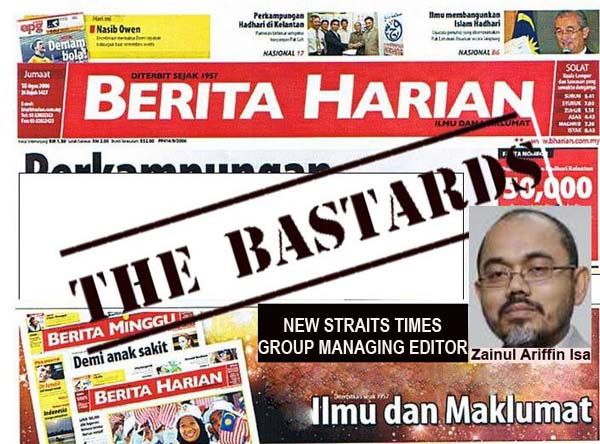

 New Straits Times Group Managing Editor Quote
“Why did the Selangor MB, a MALAY , question those of his own RACE to act fairly?” -Zainul Ariffin IsaNew Straits Times Group Editor
The number of Internet newspapers has mushroomed from one to eight over the past two years, with new titles appearing in Chinese, Malay and English to cater to the multicultural population.
By CLARK HOYT
Published: August 1, 2009
THE TIMES published an especially embarrassing correction on July 22, fixing seven errors in a single article — an appraisal of Walter Cronkite, the CBS anchorman famed for his meticulous reporting. The newspaper had wrong dates for historic events; gave incorrect information about Cronkite’s work, his colleagues and his program’s ratings; misstated the name of a news agency, and misspelled the name of a satellite.
“Wow,” said Arthur Cooper, a reader from
The short answer is that a television critic with a history of errors wrote hastily and failed to double-check her work, and editors who should have been vigilant were not.
But a more nuanced answer is that even a newspaper like The Times, with layers of editing to ensure accuracy, can go off the rails when communication is poor, individuals do not bear down hard enough, and they make assumptions about what others have done. Five editors read the article at different times, but none subjected it to rigorous fact-checking, even after catching two other errors in it. And three editors combined to cause one of the errors themselves.
Seemingly little mistakes, when they come in such big clusters, undermine the authority of a newspaper, and senior editors say they are determined to find fixes. The Times seems to have particular difficulty in writing about people after their deaths. In addition to the appraisal in the Arts section, a front-page Cronkite obituary had two errors of its own, and the paper has suffered through a recent string of obits with multiple errors. Craig Whitney, the standards editor, said late last week that an editor is being added to the obituary department to fact-check and work with the staff to reduce “unacceptably high error rates.”
The Cronkite episode suggests that a newsroom geared toward deadlines needs to find a much better way to deal with articles written with no certain publication date. Reporters and editors think they have the luxury of time to handle them later — and suddenly, it is too late.
What Sam Sifton, the culture editor, ruefully called “a disaster, the equivalent of a car crash,” started nearly a month before Cronkite died, when news began circulating that he was gravely ill. On June 19, Alessandra Stanley, a prolific writer much admired by editors for the intellectual heft of her coverage of television, wrote a sum-up of the Cronkite career, to be published after his death.
“This is my fault,” she said. “There are no excuses.”
In her haste, she said, she looked up the dates for two big stories that Cronkite covered — the assassination of Martin Luther King and the moment Neil Armstrong set foot on the moon — and copied them incorrectly. She wrote that Cronkite stormed the beaches on D-Day when he actually covered the invasion from a B-17 bomber. She never meant that literally, she said. “I didn’t reread it carefully enough to see people would think he was on the sands of
June 19 was a Friday, a heavy time for the culture department, which was processing copy for Saturday, Sunday and Monday. Lorne Manly,
Though the correct date of the moon landing was fresh in his mind, Manly said, he read right over that mistake. Catching it might have flagged the need for more careful vetting. For all her skills as a critic,
Janet Higbie, a copy editor, said she started reading the article that Friday and caught the misspelling of the Telstar satellite and the two incorrect dates, but fixes she thought she made didn’t make it into the paper. “I don’t know what happened,” she said. Higbie said she had to drop the story and jump to deadline work, and she assumed that someone else would pick up the editing later. No one did — for four weeks, until Cronkite died late on another busy Friday. “It fell through the cracks,” Higbie said.
Two days before his father died, Chip Cronkite sent me an e-mail message labeled, “pre-emptive correction.” He said that CBS, in reviewing its obituary material, had found inaccuracies. “As a life-long admirer of your newspaper,” he said, “may I suggest that you have someone double-check ahead of time?”
Douglas Martin, who had written an advance obit of Cronkite several years earlier, phoned Chip Cronkite. They went over spellings, discussed the cause of death and the like. No one thought to forward Chip Cronkite’s message to the culture department, where
When his father died on July 17, Chip Cronkite said he called CBS and then The Times, at 8:01 p.m. Laurel Graeber, who was running the culture copy desk, said she didn’t get the word for half an hour. Work had just finished on the Saturday Arts section, and most of the editors had gone home. Past deadline, Amy Virshup, a deputy culture editor, decided to put
And, it could have been worse. Nicole Herrington, a late-shift editor reading the appraisal casually, decided to check a fact near the top — Cronkite’s age when he retired. It was wrong. He was 64, not 65. Virshup then headed off the same mistake in the Page 1 obituary.
Looking back at it all — a critic making mistakes in haste, editors failing to vet her work enough, a story sitting for weeks without attention and then being rushed through — one sees how small missteps lead to big trouble, leaving readers to wonder what they can trust.
Chip Cronkite seemed philosophical about all the errors. He said his parents had a joke ashtray with the inscription, “Just give me the facts: I’ll mix ’em up when I quote you.”


No comments:
Post a Comment