


related article Dr Mahathir’s perfact Cosmetic Surgery on KTM
Remember Indira Gandhi's left turn in 1969? Supposedly for Garibi Hatao, she nationalized banks, abolished privy purses and raised income tax to 97.75%. Leftist ideologues cheered deliriously.
But a few years later, she declared an Emergency and jailed all opponents, leftist or rightist. Her great left turn was not ideological, but a ploy to maximize personal power.
Her left turn was an economic failure: poverty did not fall at all. But it was a massive political success. She crushed the old Congress leadership (called the Syndicate).The main opposition party in 1967 was the Swatantra Party, a coalition of princes and big business. Abolition of privy purses bankrupted the princes, and high income tax rates bankrupted the business class. The Syndicate and Swatantra Party crumbled before her. Only when she put Swatantra, Syndicate and CPM leaders in jail together did it become clear that ‘garibi hatao' was a cloak for ‘opposition hatao'.
Warning: don't be misled by Rahul's supposed left turn. He too is engaged in very practical politics to oust opponents. He has targeted non-Congress states in his campaign against displacement.
Recently, he went to Orissa as champion of the tribals whose land was being usurped by industrialist Anil Aggarwal for his aluminium factory. Yet, his real target was not Aggarwal but BJD chief minister Naveen Patnaik. After being thrashed by Patnaik three elections in a row, Rahul badly needs a new issue to regain lost ground.
He now plans a visit to Kerala, to support tribals protesting against their land being given to a windmill farm of Suzlon. Guess what: Kerala too is an opposition state, ruled by the CPM-led Left Front.
Corruption and callous treatment of tribals has been widely alleged in the coal and iron ore blocks in Jharkhand, Chhattisgarh and Madhya Pradesh. Rahul can afford to bash all three chief ministers, because they belong to the BJP. Winning tribal support here is simply another way of winning back lost ground, including ground lost unwittingly by killing innocents in the campaign against Maoists. You did not hear of Rahul campaigning for tribals when his own party was a coalition partner in Jharkhand.
Illegal iron ore mining is the bane of Karnataka. The Reddy brothers, accused of being the main illegal miners, are now ministers in the BJP cabinet. Naturally, Congress has blasted them. Yet the Reddy brothers respond that the state Lokayukta says companies owned by Congress leaders - M Y Ghorpade, V S Lad and sons, Allum Veerabhadrappa, H G Ramulu, S M Jain and Abdul Wahab — have encroached on hundreds of acres. Congress has not castigated these gentlemen.
Indeed, quite recently, the Reddy brothers were into illegal mining by encroaching on forests in neighbouring Andhra Pradesh. They were backed by former Congress chief minister Rajasekhara Reddy, and so bureaucrats dared not act against their encroachment. Only when Rajasekhara Reddy died, and his son Jagan failed in the struggle to succeed him, was it possible to take any action.
Goa is a major producer and exporter of iron ore. The Centre for Science and Environment has written passionately about the anger of local people against environmental damage by the mining companies. But this is a Congress-ruled state, so the mining giants are not in bad odour. Indeed, the biggest mine-owner in Goa is none other than Anil Aggarwal, the very gentlemen castigated by Rahul in Orissa.
By coincidence, almost all the states with embittered tribal populations are ruled by opposition parties. Even other states with agitations against land acquisition — West Bengal, Uttar Pradesh — are opposition-ruled. The fact is that Congress rules very few states on its own, and is often a junior partner where it is part of a ruling coalition. So, Rahul can afford to go on the offensive on land acquisition and tribal displacement.
This is not entirely cynical politics. Land displacement has become a mass issue. Politicians have responded, and i am delighted that the once-powerless tribals are getting some justice. More power to Congress on this. Still, remember that these tribals received far less justice in the old days of Congress hegemony.
We should welcome the change. But let us not attribute this to a sudden ideological left turn on Rahul's part. Like his grandmother, but without her high-handedness, he is resorting to the old strategy of using ideology when it suits his family's quest for power.

Prime Minister Datuk Seri Najib Razak met his Singaporean counterpart Lee Hsien Loong and accepted the offer for four land parcels in Marina South and two pieces in Ophir/Rochor in exchange for three parcels of KTM land in Tanjong Pagar, Kranji and Woodlands, and three pieces in Bukit Timah.
MS Pte Ltd, a 60-40 joint venture between the respective sovereign wealth funds, Khazanah Nasional Berhad and Temasek Holdings, will handle the six Singapore land parcels for joint development when KTM vacates the Tanjong Pagar railway station to the Woodlands train checkpoint by July next year which will also have the Malaysian Customs, immigration and quarantine facilities.
The four Marina South parcels are located in Marina Bay, while the two Ophir-Rochor sites are next to the Kampong Glam historic district in a new growth corridor that is being developed as an extension of Singapore’s Central Business District, according to the republic’s Straits Times newspaper.
The two leaders, however, could not agree on the development charges payable on the three KTM land parcels in Tanjong Pagar, Kranji and Woodlands.
They have agreed to settle the issue amicably through the Permanent Court of Arbitration, and will “accept the arbitration award as final and binding”, said a joint statement issued by the two PMs after their talks in Singapore.
Diplomatic sources said Singapore had referred to its land laws on the development charges but Malaysian officials working on the deal wanted a higher valuation without paying the higher charges.
“Arbitration seems the only way, otherwise the deal won’t go through,” a diplomatic source told The Malaysian Insider, adding any delay will see the KTM land revert back to Singapore without any compensation after June 2011.
Speaking to reporters after the talks with Lee, Najib said the deal is “mutually beneficial”.
Both prime ministers said it enables the two sides to move forward and co-operate on other issues like the planned rapid transit system and development of a wellness township project in Iskandar Malaysia.
A joint implementation team will also complete discussion on the details of the implementation of the Points of Agreement (POA) by December 31. The POA was signed in 1990 by then-Singapore PM Lee Kuan Yew and Malaysian Finance Minister Tun Daim Zainuddin.
This is the third round of talks between the two leaders since May when they announced that a solution has been found to ensure the POA are implemented.
When both leaders last met in Putrajaya in July, they had agreed to meet again after Hari Raya Aidilfitri to settle the land swap due to a difference of opinion on the land valuation and the tenure of the land holding.
Both Najib and Lee first announced their agreement on the 20-year issue on May 24 when they disclosed that the rail land swap would see the joint-venture M-S Pte Ltd given three parcels of land in Tanjong Pagar, Kranji and Woodlands, and an additional three parcels of land in Bukit Timah (Lot 76-2 Mk 16, Lot 249 Mk 4 and Lot 32-10 Mk 16) for the joint development of the said parcels.
Future railway links between the two neighbours would include a rapid transit system link between Tanjung Puteri, Johor Baru and Singapore. The rapid transit system link will be integrated with public transport services in both Johor Baru and Singapore.
The rapid transit system link would have an integrated Malaysian and Singaporean Customs, immigration and quarantine facility located in Singapore, which will be operational by 2018 although the exact location has yet to be determined.
Both leaders also agreed that Malaysia might consider relocating the KTM station from Woodlands to Johor when the rapid transit system link is completed.
Nobel Laureate in Economics Amartya Sen in his book ‘Development as Freedom’ states that freedom is the most effective way of sustaining economic life. He also puts a premium on education as key to eradicating poverty and raising income levels.
The private sector performs well under conditions of minimal government rules and regulations. Overzealous implementation of the NEP created administrative obstacles and led to corruption. Dr. Mahathir is silent about his crony politics.
I have always felt that luck favored Mahathir. After the Plaza Accord in 1985 when the yen was revalued, Japanese companies sought low cost locations. Wages in Malaysia were low then and Mahathir’s Look East Policy favored the Japanese. In fact, Mahathir went out of his way to court FDIs from Japan and South Korea. Professor Dr. Ariff is spot on.
Times have changed. We are now in the 21st century.Mahathir is dreaming of the past. Our labour cost is high and most of Malaysian companies have to rely on relatively cheap labour from ASEAN countries like Bangladesh,Cambodia Indonesia, Myanmar and Vietnam. This cannot continue because these economies are also growing.
Policies must change to enhance national productivity, and that is the idea behind the New Economic Model–to get us to move from middle-income to high-income economy. Innovation and technology have to drive it since our production cannot be competitive if we remain dependent on labour intensive industries and old production methods. Here human capital development is priority.
Najib’s NEM has yet to show us how human capital, innovation and services would be addressed to sustain our future economic development. Affirmative Action policies must be pro-Malaysians, not just the Malays. Mahathirism (crony capitalism) should be abandoned for good if we are to move forward.
As for Mahathir, he should learn to keep his mouth shut since his ideas about the economy are driven by politics, personal interest, and outmoded theories of economic development.
Malaysia’s Rapid GDP Growth: External Factors not NEP,
says Professor Datuk Dr Mohamed Ariff
 The country’s premier economic think tank’s ex-chief questioned Tun Dr Mahathir Mohamad’s assertion that the country grew rapidly due to the New Economic Policy (NEP), and instead said Malaysia should thank external factors.
Professor Datuk Dr Mohamed Ariff, distinguished fellow at the Malaysian Institute of Economic Research and its former executive director, also suggested that Malaysia could have grown even faster if the NEP restrictions were absent.
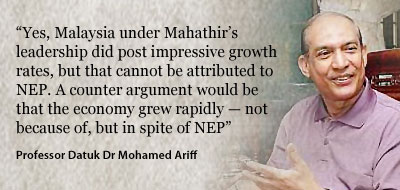
“Mahathir’s argument that the country had developed more rapidly under NEP is questionable,” Ariff told The Malaysian Insider.“Yes, Malaysia under Mahathir’s leadership did post impressive growth rates, but that cannot be attributed to NEP. A counter argument would be that the economy grew rapidly — not because of, but in spite of NEP.The high growth rates Malaysia registered during Dr M’s premiership was largely due to very favourable external circumstances, driven mainly by strong external demand for exports.”
 He also warned that the external factors are much less favourable now and NEP type policies could not help the nation. “NEP constraints will impair the country’s competitiveness in an increasingly competitive environment,” said Ariff.
Mahathir said on Thursday that the country has developed more rapidly under the NEP and the country’s performance outpaced other developed nations.
The former prime minister had also said that the controversial NEP, which was introduced in 1971 and

Malaysia's Economic Guru
gave economic and other privileges to the Malays, was to help them catch up to other communities and prevent racial riots.
Ariff said that affirmative action was relevant but Bumiputeras were shortchanged by the NEP as it benefitted the elite rather than the poor masses.
“The NEP version of affirmative action could not trickle down as the lion’s share of the benefits were arrested at the top by politically well connected people,” said Ariff. “No one would deny that all Bumiputeras have got something out of it one way or another, but what they got was crumbs falling out of the table.”
Malaysia, once counted as among Asia’s most prosperous countries in the 1960’s and even through parts of the 1970’ fell behind in the following decades.
Despite relatively high growth rates it is not kept pace with its Asian counterparts such as Singapore, South Korea, Hong Kong and Taiwan which are now regarded as developed high income countries.
Prime Minister Datuk Seri Najib Razak has said, however, that affirmative action will be made more transparent and market friendly as part of his new economic reforms to boost the country’s competitiveness.
No comments:
Post a Comment