

Among many constitutionally protected rights, two stand out and they are contradictory: freedom of speech; and the right to remain silent. No one can prevent you from speaking. No one can force you to speak. There is a constant chorus respecting the freedom of speech. Little is heard respecting the right to remain silent. But many more Americans remain silent than speak.
There are more reasons than we can count for the decision to remain silent. Nobody cares what I think. I don't really understand the issues. I'm confused by all the noise. I'm not smart enough. I'm too busy. And so it goes. All of which is fine, except silence conveys assent. Assent for the status quo. Assent for the majority opinion. Assent for the loudest voices and largest megaphones. Silent people are either happy people, or people who don't care, or people so angry they can't form a statement.
I don’t understand why certain people are still oblivious to the country’s current political reality and have not learned a lesson from their past lapses.
For example, prosecuting Rafizi Ramli.
Sure enough the government has every right to prosecute. Indeed this is part and parcel of a society ruled by law.
That said, this power of prosecution has to be exercised prudently. Individuals’ freedoms and civic rights must not be compromised while the principles of social justice have to be adhered to.
A fair and just prosecution will ensure any slightest doubt of political persecution is dispelled.
It is hard for the prosecution against Rafizi to rule out any such doubt.
Making of a star
Rafizi started to emerge from obscurity and into the limelight after his revelation of the National Feedlot Centre scandal.
Along the way, he has held in his possession a good deal of raw information that he, an accountant by training, analysed to bring his findings to light.
There are few politicians with such professional qualities in this country.
Not someone with respectable political experience to his credit, Rafizi is nevertheless endowed with an exceptional aptitude in politics.
He has not laid everything on the floor and set off a bomb to end it all just like that. On the contrary, he was slowly peeling off the onion, layer by layer.
With every layer he peeled back, people from the NFC or some political party would stand up to deny, and fall into his trap by doing so.
Thanks to his revelation, NFCorp chairman Mohamed Salleh Ismail was charged in a court, and his wife Shahrizat Jalil lost her Cabinet post.
Rafizi’s sterling performance in the NFC disclosure has opened the eyes of Malaysians to the rise of a new sparkling political star.
Public interest
The Malaysian government now decides to charge Rafizi for disclosing the NFC accounts; he can be fined RM3 million or jailed three years if convicted.
Indeed Rafizi has been implicated in the disclosure of classified information, but what if such disclosure has been done in the interest of the public?
Moreover, the prosecution could have contradicted the Whistleblower Protection Act 2010, created by the government to fight corruption.
Under the Act, informers exposing corrupt practices and other misconduct shall be immune from all civil and criminal charges.
Rafizi should be protected from, not subjected to, such charges.
Unwise
Politically speaking, prosecuting Rafizi is an unwise strategy.
A new generation PKR leader often associated with a clean image, Rafizi has no past alliances with the Umno.
His open debate with Khairy Jamaluddin in Kuala Lumpur merely two months ago bore witness to his eloquence, sense of humour and gentleman-like disposition.
Trying to bog down a rising star in politics will only invite more backlash from the public, doing him a huge favour by boosting his popularity.
Like Julius Caesar crossing the Rubicon, there is no turning back now for Rafizi. Prosecuting him will only energise him in his forward charge.
Richard Nixon's political strategy focused on something he called "the silent majority." Most people were silent and his assumption was they were silent because they agreed with him and didn't care to let anyone know it. Why they had strong Nixonian opinions and didn't voice them was never clear.
Sometimes people are silent because they know their opinions would meet with disapproval from those whose opinions are respected.
In the political arena, the most vocal groups and causes get the attention from media and politicians alike. A few journalists still knock on doors and conduct their own polls in silent living rooms. But these are rare, random, and anecdotal. They rarely crack the code of the silent majority.
And then there are those who have very strong opinions that they do not express because they can't make the pieces fit together. They want lower taxes, less government spending and balanced budgets. But they also want the government programs that benefit them to remain untouched. And when challenged to work out the numbers, they can't go beyond the simplistic slogans. So they are happy to let the media figures who say what they want to hear speak for them.
The prosecution has withdrawn its appeal over a summons charge against former Commercial Crime Investigation Department (CCID) Director Ramli Yusuff at the Court of Appeal recently.
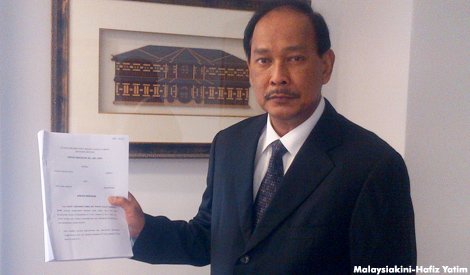
Following this, the government has agreed to pay Ramli’s backdated gratuity and pension, amounting to RM753,000, which had been withheld after he was suspended three months before he was due to retire in late 2007.
Ramli told Malaysiakini that he had received a letter dated July 12 informing him of the prosecution’s withdrawal. “This is the last of five charges which I had wrongly been accused of since 2007,” he said.
“I have pledged to use all this gratuity money received to help build a mosque in my hometown of Kampung Bunut Susu, Pasir Mas. I have made this pledge since being charged as I want my name cleared,” said the former top cop.
Initially the prosecution’s appeal to the summons charge has been fixed for Aug 22 at the Court of Appeal, and although the letter from the prosecution was dated July 12, he received it on July 23.
Ramli said he had been cleared before nine judges in total for the five charges which he had faced in Sabah and Kuala Lumpur. “It’s been a long road of five years where I had to find lawyers and find funds for them to clear my name,” he said.
 Ramli was alleged to be the RM27 million cop by the Malaysian Anti-Corruption Commission (MACC) way back in 2007 following his team’s investigations into what is now known as the Copgate affair allegedly involving then Inspector-General of Police Musa Hassan, and which also allegedly involved Attorney-General Abdul Gani Patail.
Earlier today, the MACC withdrew its appealagainst lawyer Rosli Dahlan’s acquittal at the Kuala Lumpur High Court.
Served with Dedication
Ramli had in 2007 faced three charges in Kuala Lumpur over allegedly failing to declare his assets and another on violating laws prohibiting civil servants from being involved in private business, which is his summons charge.
He was also acquitted of a charge of abuse of power when as Sabah police chief he allegedly used a Royal Malaysian Police Cessna Caravan aircraft to fly him and Brig-Gen (Rtd) Mohamad Yasin Yahya on aerial surveillance of two parcels of land in Ulu Tungku and Lahad Datu.
The former top cop said he had served with the Police force for 37 years, 10 months and 23 days and he served the country with full dedication before he was charged.
“My investigation diary has been used as a manual by the Police force to teach young recruits. I had worked to enforce the law without fear and favour,” he said.
“In Sabah where I was a former state Police chief, we had managed to reduce the arrival of illegal immigrants and hence reduce crime. My record as Pahang police chief also speak for itself,” he said.
Ramli also revealed that former Sabah Chief Minister Chong Kah Kiat, who attended his birthday celebration earlier this year, had paid tribute to his good record and said that if he (Ramli) stood for election in Sabah he would win.
‘Respect Whistleblowers’
 Ramli also had strong words to the government and enforcement agencies to respect and protect whistleblowers.
“I can relate to what is happening with (PKR strategic director) Mohd Rafizi Ramli and the former bank clerk who were chargedyesterday, as my men had faced the same things,” he said.
“The authorities should go after the real criminals and not those who reveal it. They are allegedly disclosing a real crime (with regards to the National Feedlot Corporation) fiasco,” he said.
When Ramli was charged, six of his Police officers who had investigated the then-Inspector-General of Police Musa Hassan’s alleged links with kingpin Goh Cheng Poh or Tengku Goh, were also charged with allegedly falsifying witness statements.
They have since been released without their defence being called and the prosecution had also dropped its case against them. They had been suspended when they were undergoing trial. Although they were reinstated last year, some of them had worked as taxi drivers to make ends meet.
Ramli had, during his birthday speech in a leap year, paid tribute to these men whom he called “fearless officers”. “All of them have been reinstated and promoted. I am glad that the (Police) force has not forsaken them,” said the former top cop during his 60th birthday speech on February 29.
He also related how the MACC had allegedly used a shady character to implicate him with the 2007 charge.
‘A-G very vindictive’
In his Copgate allegation, Ramli had stated how Attorney-General Abdul Gani  Patail had used the then Anti Corruption Commission, which is now the MACC, to harass whistleblowers who had implicated Musa with Tengku Goh to reverse their statements.
 Patail had used the then Anti Corruption Commission, which is now the MACC, to harass whistleblowers who had implicated Musa with Tengku Goh to reverse their statements.
However, these whistleblowers had also met former Deputy Home Minister Johari Baharom, complaining that they had been asked to turn over, and had also drawn up affidavits to state that what they had stated earlier to Ramli’s officers were correct.
Ramli told Malaysiakini that Abdul Gani was very vindictive against him. “I have been acquitted and yet they have decided to appeal until they agreed to withdraw the final case,” he said.
He said despite retiring he will continue to serve the people. He has also been a practising lawyer since he was charged.


Abdul Gani has, however, denied owning any bungalow or property in Seremban when posed the question.
Low, who is the son of Ho Hup founder the late Low Chee, and the family still hold a substantial stake in the company said the company has also filed several suits against Lye. He added that after lodging the Police reports last month that the commercial crime unit had recorded his statement.
Americans fight and die for principles such as freedom of speech. Few of them think of dying for the right to remain silent.
"And in the naked light I saw ten thousand people, maybe more,
People talking without speaking. People hearing without listening. People writing songs that voices never share.
And no one dared
The CAG had used the 3G licence value of Rs 16,750 crore obtained by the government in auction for 5Mhz band to arrive at the figure of Rs 1.76 lakh crore. "And this base price was made the benchmark also because the Telecom Regulatory Authority of India (TRAI) had in an earlier report endorsed this price parity," said a senior CAG official.
The main criticism of the policy followed under A Raja's term as the telecom minister was that in 2008, the government had allocated spectrum free with licences and at a price that was fixed in 2001.
After CAG came out with its 2G report in 2010, telecom minister Kapil Sibal was joined in by his other Cabinet colleagues and party leaders in criticizing the top auditor for exceeding its brief and delving into policy matters that was exclusively the government's prerogative. Sibal, who was part of the Cabinet decision on Friday to set the base price at Rs 14,000 crore, had then emphasized that it was a zero sum loss — for the licences allocated by Raja without auction in 2008 — to the exchequer and that CAG had lost its mind.
In fact, a cautious TRAI had this time recommended a reserve price of over Rs 18,000 crore for 5MHz spectrum in the 1800 band, which was 20% higher than what the Cabinet has settled for.
A recent internal appraisal made by CAG on quantifying losses in its reports says it was because of its initiative to highlight policy lapses that the CBI intensified its investigation and several arrests were made (in the 2G spectrum case).
"As the scrutiny of the issue grew and truth began to surface, the intensity of accusations against the CAG also increased," it observed.
The CAG's internal paper blamed the government for not taking its report seriously and relegating it for "evaluation" by a Joint Parliamentary Committee (JPC). "The report which had to be taken to logical conclusion in the form of meaningful recommendations of the Public Accounts Committee fell prey to parochial politics and the PAC's report never saw the light of the day," the CAG said.


No comments:
Post a Comment